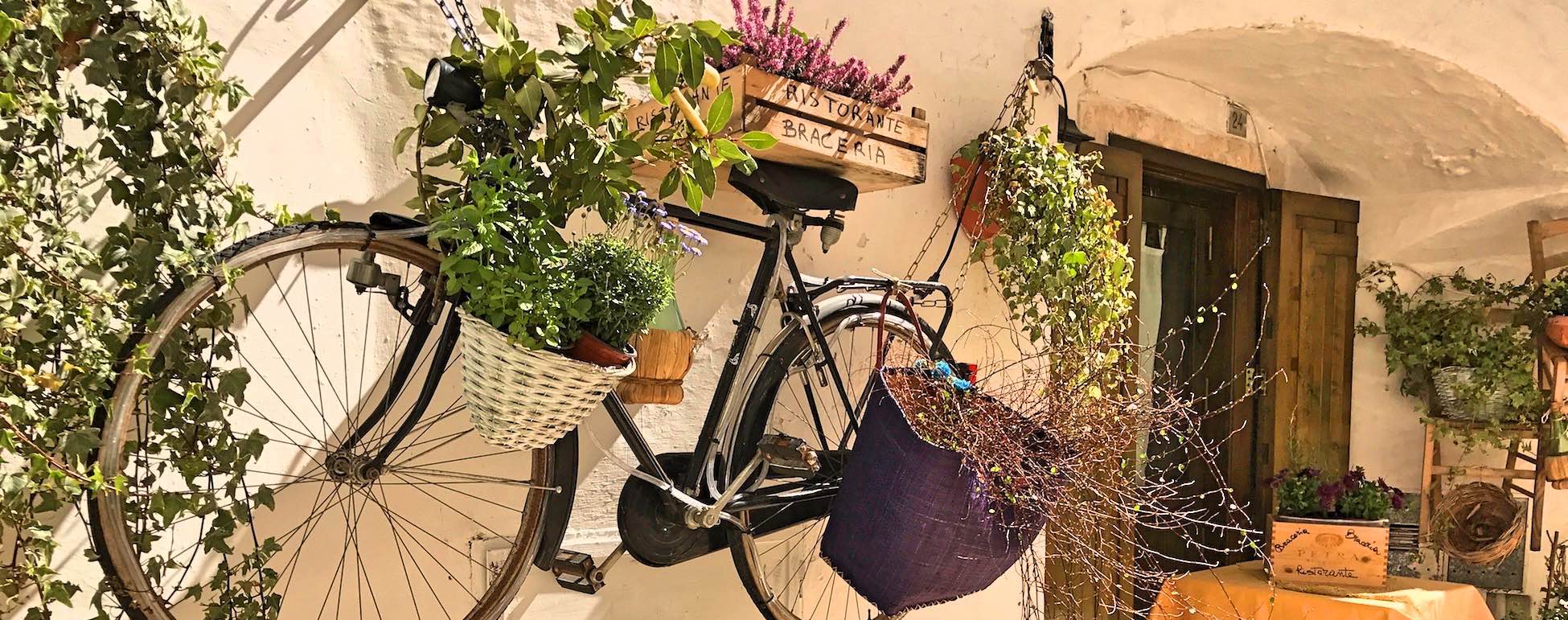


Castronovo di Sicilia is a small village in the Sicani Mountains, in the heart of Sicily, between Palermo and Agrigento, where history, nature and traditions come together.
The history of Castronovo di Sicilia dates back to prehistoric times, when the area was inhabited by the Sicani, one of the oldest peoples of the island, who settled on Mount Kassar. Over the centuries, the village was crossed by Greeks, Romans, Byzantines, Arabs and Normans, thanks also to its strategic position.
What to see in Castronovo di Sicilia
The historic centre of Castronovo preserves evidence of different historical periods. Walking through its narrow streets, churches, fountains and ancient neighbourhoods allows you to discover part of the village's long history.
Batia District
The Batia district is one of the most authentic corners of Castronovo di Sicilia.
Of Arab origin, it still preserves its medieval layout, characterised by narrow streets, stone arches and picturesque views, perfect for exploring at a leisurely pace.
One of the places worth seeing is Fonte Rabato, one of the village's most characteristic historic fountains. Built near the ancient spring from which it takes its name, it still has a long stone basin, small side fountains decorated with original animal-shaped masks and the old public washhouse, once a meeting place for the local community.
Not far away is Fonte Regio, another important monumental fountain in Castronovo. The large drinking trough, more than fifteen metres long, is decorated with a royal coat of arms carved in bas-relief and two stone masks placed on either side.
The visit to the district can continue to the Church of Santa Caterina d'Alessandria, also known as the Church of the Badia, and through the narrow streets that still preserve the village's most intimate atmosphere.
Mother Church of the Holy Trinity
Among the things to see in Castronovo di Sicilia, the Mother Church of the Holy Trinity should not be missed.
Its history is connected to the Norman period. The church was built incorporating some structures of an ancient Norman castle dating back to 1091. Two towers from the original fortifications still remain: one was transformed into a bell tower, while the other was incorporated into the apse area.
The church was opened for worship in 1388 and consecrated to the Holy Trinity in 1404.
Inside, the Latin-cross layout and single nave house numerous works of art. Among the highlights are the altars decorated with yellow Kassar marble, the eighteenth-century wooden choir and the Madonna Annunziata from the 16th century.
Also particularly interesting are the stuccoes created by Castronovo-born artist Antonio Messina, which testify to the artistic and religious richness of the village.
Reading this article and already dreaming of visiting Sicily?
Discover our 3 travel ideas and start planning your next adventure in Sicily!
The Magna Via Francigena
from Palermo to Agrigento

Western Sicily Walking Tour
from Palermo to Trapani

Flavours of Sicily by Bike
from Palermo to Agrigento
What to do in Castronovo di Sicilia
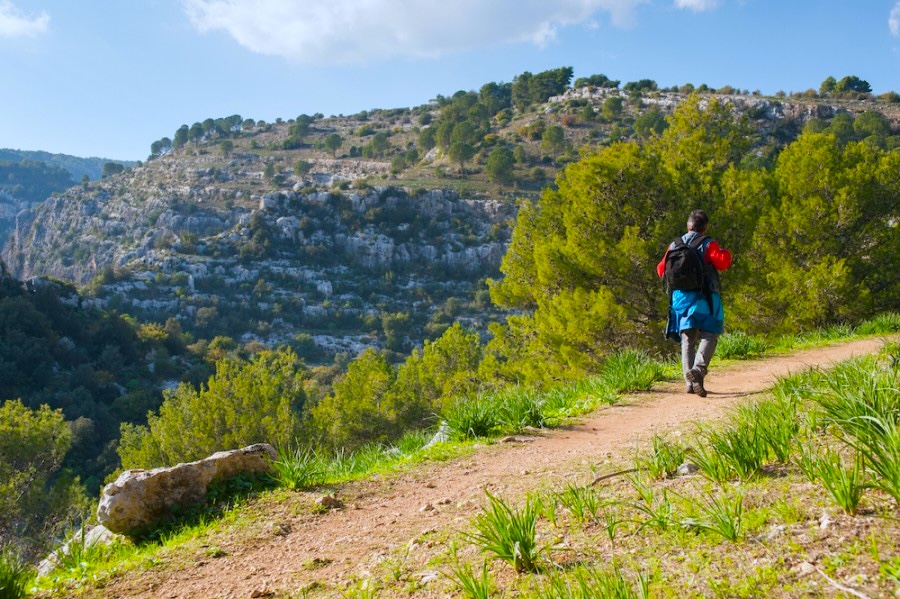
Castronovo is not just a village to visit. Its surroundings are ideal for those who want to combine culture and outdoor activities, following trails and rural roads through the landscapes of the Sicani Mountains.
Colle San Vitale and Montagna Reale
Colle San Vitale, also known as Montagna Reale, is one of the most interesting places to explore around Castronovo.
Already frequented in ancient times, the hill preserves evidence of the different civilisations that inhabited the area, from the Greeks to the Middle Ages.
During the Arab period, the Emir's Castle was built here and was later expanded by the Normans. The hill thus became an important political and military centre.

It was precisely here, in 1302, that negotiations began which led to the Peace of Castronovo between the Aragonese and Angevins, one of the most important episodes in medieval Sicilian history.
Today, walking on Colle San Vitale means moving through a landscape where history and nature coexist. The walls of the ancient castle and medieval defensive structures are still visible.
Along the route you will also encounter the Church of the Just Judge, with remains of Byzantine decorations, and the ancient Church of Madonna dell'Udienza, once the seat of the Greek-Byzantine Mother Church.
The visit is completed by the Church of San Vitale, built on the remains of the ancient palatine chapel connected to the Norman castle and dedicated to Castronovo's patron saint.
Belvedere dei Cappuccini
In the area of the ancient Arab district of Rakalbiat stands the former Capuchin Convent.
The Capuchin friars arrived in Castronovo in 1533, while the present complex was built in the 17th century. Today it has become a Franciscan Oasis, a place of hospitality and spirituality for pilgrims and visitors.
Inside is the church of Santa Maria della Bagnara, known as La Bagnara, which preserves ancient wooden tabernacles, statues and paintings.
It is a place to stop for a few minutes, away from the pace of fast tourism, surrounded by history, faith and silence.
The rural settlements of Castronovo di Sicilia: discovering rural Sicily
To truly get to know the area around Castronovo, it is worth leaving the village centre and following the traces of its ancient rural settlements.
Surrounded by the countryside of the Sicani Mountains, these small settlements tell the story of a rural Sicily shaped by agriculture, monasteries, ancient roads and farming traditions.
Among the most important is San Pietro, where a church of Byzantine origin once stood and where, in 1391, the famous parliament of the Sicilian barons met. For a long time, the area was also home to one of the most important fairs in inland Sicily.
Particularly evocative is the Byzantine Monastery of Santo Stefano di Melia, one of the most important Basilian monasteries of medieval Sicily.
Founded between the 5th and 6th centuries, it stood in a strategic position along an ancient communication route, overlooking what is now Lake Fanaco. Today, some remains are still visible, including the ancient courtyard and a characteristic octagonal fountain of Byzantine tradition.
Riena and Rakalcassi complete this journey through small rural settlements and traces of a territory that for centuries played an important role in the agricultural and cultural history of Sicily.
For those who love trekking, history and slow travel, this is a different way to discover the island: not through its most famous destinations, but by following the traces of an everyday Sicily that is still deeply connected to its land.

Nature in Castronovo di Sicilia: Sicani Mountains, forests and lakes
One of the reasons to visit Castronovo di Sicilia is the opportunity to combine history and nature.
The village is a starting point for exploring the Sicani Mountains, among mountains, forests, lakes and waterways.
Monte Carcaci is one of the most interesting natural areas in western Sicily.
Located within the Sicani Mountains Park, it features holm oak forests, trails and rich biodiversity. It is an ideal environment for trekking, hiking and birdwatching.
Monte Kassar is one of the symbols of Castronovo di Sicilia.
In addition to its historical and archaeological importance, the mountain is known for its quarries, where the valuable Castronovo yellow marble was extracted and used over the centuries to decorate churches and palaces throughout the island.
From the summit, wide views open across the valleys and the landscape of the Sicani Mountains.
Water is an important element of the Castronovo landscape.
The Platani River, one of Sicily's main waterways, crosses countryside rich in history and still preserves traces of the area's ancient rural economy, including the old water mills.
Its banks are ideal for walks and moments of tranquillity surrounded by nature.
Lake Fanaco, surrounded by the Sicani Mountains, offers a particularly evocative landscape.
Its calm waters and surrounding forests make it an interesting destination for hiking, photography and slow travel.
Near the lake lies the Pizzo Lupo Forest, a large woodland crossed by trails among pine trees, oaks and Mediterranean scrub.
Walking through the forest, you can enjoy views over the Platani Valley and encounter archaeological remains that tell the story of how ancient human settlement in this area is.
Discover Castronovo di Sicilia with a guided tour
Castronovo di Sicilia tells its story through its streets, churches and the traces left by the different civilisations that have crossed this territory. To discover the village in greater depth, you can take part in a guided tour of Castronovo di Sicilia, exploring its history, art, culture and traditions.
The route takes you through the different periods that shaped the history of the village: from the indigenous populations to the Hellenic peoples, from the Romans to the Byzantines, and from the Arabs to the Normans. Along the way, the history of the area is brought to life, together with archaeological and documentary evidence that still remains visible today.
Urban itinerary: discovering the historic centre
The tour begins at Largo Fra Vitale Lino and continues through the streets of the historic centre of Castronovo di Sicilia.
During the walk, you will encounter some of the village's main artistic and historical landmarks:
- Capuchin Convent
- Church of Calvary
- Church of Santa Rosalia
- Chapel of the Addolorata
- Church of San Francesco
- Duomo
- Church of Madonna del Rosario
- Piazza Pepi
- Church of Santa Caterina d'Alessandria
- Rabat District
- Colonna Frumentaria
- Palazzo Giandalia
- Fonte Regio
An itinerary designed to slowly enter the heart of Castronovo, combining architecture, history and stories connected to the life of the local community.
Extra-urban itinerary: Montagna Reale
For those who want to venture beyond the village centre, the tour can continue along an extra-urban route towards Montagna Reale, combining landscapes and historical traces.
The route starts from Largo Fra Vitale, with an introduction to the history of Castronovo di Sicilia and the churches encountered along the way.
The itinerary includes:
- Colle San Vitale
- Church of the Patron Saint
- Church of the Udienza
- Church of the Just Judge
- Scala del Re and Piano delle Donne
- Church of Santa Maria dei Miracoli
- traces connected to the Teutonic Knights
A route that allows you to read the territory not only through its monuments, but also through its landscape and the traces left by the communities that have lived here over the centuries.
Festivals and Popular Events in Castronovo di Sicilia
Traditions are an important part of Castronovo's identity.
Throughout the year, the village hosts food festivals, religious celebrations and local events that offer an opportunity to discover the local culture and gastronomy more closely.
Among the most eagerly awaited events are Estate Castronovese, which brings the village to life during August with shows, events and the traditional “Vitino Pinto” neighbourhood competition, the Peach and Pear Festival and the Truscitedda Festival.
The most deeply felt religious celebrations include:
- the Feast of San Vitale, patron saint of Castronovo, on 9 March and again in August;
- the Feast of the Most Holy Crucifix, on 3 May;
- the Feast of San Giuseppe, with the traditional table featuring thirteen dishes;
- the Feast of the Assumption, on 15 August;
- the Feast of Madonna della Bagnara, on the second Sunday of September.
Particularly evocative is Holy Week, when processions and centuries-old rituals culminate in the traditional “Risuscita” celebration on Easter Sunday.
Taking part in one of these celebrations means discovering a community that remains deeply connected to its traditions, where faith, food and popular culture continue to intertwine.

Typical dishes of Castronovo di Sicilia
The cuisine of Castronovo di Sicilia reflects the traditional food culture of inland Sicily: simple ingredients, local products and recipes handed down through generations.
The area is particularly known for its cheese production. One of the local specialities is Tuma Persa, an ancient cow's milk cheese whose production was revived after a long period of neglect. Other local specialities include Fiore Sicano (Tumazzu di vacca) and Pecorino DOP.
Traditional first courses include:
- pitirri, made with semolina;
- pasta with wild fennel and sardines;
- pasta e frittedda;
- fresh homemade pasta.
Traditional cuisine also includes dishes such as brusciulune, castrato, wild asparagus meatballs and various preparations based on seasonal vegetables.
Among the foods traditionally shared at the table are cudduruna, 'nfriulata, sfinciune and pane cunzato.
Sicilian pastry-making also follows the rhythm of the festive calendar: from frutta martorana and tetù for All Souls' Day to buccellati and Christmas sweets, as well as Carnival cannoli, Castronovo cassata and Easter specialities.
Because getting to know Castronovo also means sitting down at the table and letting its cuisine tell the story of the territory.
Eating and drinking in Castronovo di Sicilia
Cuba Libre, Atrio Scuole Elementari. Ideal for an aperitif or simply a snack, with cocktails, refreshing granitas, sandwiches and local products.
Pasticceria Sparacello, Corso Umberto I, 167. High-quality pastries prepared with professionalism and passion.