
In the heart of the Taranto Murgia, just a few kilometres from Taranto, lies Crispiano, a village known as the “Town of a Hundred Masserie”.
An appellation that perfectly captures the identity of the area: nowhere else in Puglia is such a large number of historic masserie concentrated within such a small area.
Crispiano’s origins date back to prehistoric times, as evidenced by the Tomba dei Tumuli, an important archaeological site from which valuable artefacts have been recovered, including some of the famous Gold of Taranto. Thanks to the fertility of its land, the area also played a significant role during the period of Magna Graecia, when agriculture was one of the main economic resources of the region.
Today's town developed around the Vallone di Crispiano, a striking karst depression that forms the historic heart of the village and gives the landscape a distinctive character. Walking through the village streets, you can appreciate the deep connection between people and nature that has characterised this part of Puglia for centuries.
During the Middle Ages, the numerous masserie that still dot the surrounding countryside began to appear. These rural complexes, once at the heart of agricultural and pastoral life, are now among the most authentic symbols of Crispiano and its history.
The period following the unification of Italy also left significant traces on the area. The woods of the nearby Bosco delle Pianelle Regional Nature Reserve became the refuge of the brigand Pizzichicchio and his band, protagonists of one of the best-known episodes of brigandage in southern Italy.
Visiting Crispiano means discovering an area where history, archaeology, nature and rural traditions coexist in harmony. It is an authentic destination for anyone wishing to explore the province of Taranto away from the most well-known routes, among historic masserie, ancient woodlands and the characteristic landscapes of the Taranto Murgia.
What to see in Crispiano
Crispiano is one of the main gateways to the Terra delle Gravine Regional Natural Park, a protected area home to woodlands, ravines, ancient olive groves and some of the most striking landscapes of the Taranto Murgia. Visiting Crispiano is an ideal choice for those who enjoy hiking, cycling and slow travel and want to discover the most authentic side of Puglia through trails immersed in nature and ancient historical sites.
From the evocative Vallone di Crispiano, with its rock churches and the Grotta della Stinge, considered the cradle of the area's first human settlement, to the famous Cento Masserie, a symbol of local rural traditions, every corner of the village tells a story. Other places not to be missed include the Bosco delle Pianelle, one of the most important natural areas in the province of Taranto, the Church of Santa Maria della Neve and the Crypt of the Abbey of Santa Maria di Crispiano, a precious testimony to the village's medieval past.
Between nature, history, archaeology and traditions, Crispiano offers plenty of opportunities for those who want to explore an authentic area away from the busiest tourist routes. Let's discover what to see in Crispiano and which attractions are not to be missed.
Grotte del Vallone
The Grotte del Vallone are one of Crispiano's symbolic landmarks and preserve the oldest origins of the village. This striking karst depression in the Taranto Murgia has been inhabited by humans since prehistoric times, as demonstrated by the numerous archaeological discoveries made in the area.
During the Middle Ages, the Vallone acquired an important spiritual role: its natural caves became a refuge for Basilian monks fleeing persecution during the Iconoclastic controversy. Here, the monks found suitable places for prayer and hermit life, leaving behind valuable evidence of the rock-cut culture that still characterises this area today.
At the end of the eighteenth century, the caves of the Vallone once again played a central role in the history of Crispiano. It was here that the first farming families from Martina Franca found shelter while cultivating the surrounding land. From this small settlement grew the first inhabited centre from which today's town would develop.
Today, the Grotte del Vallone di Crispiano are among the most fascinating attractions to visit, a place where nature and history meet. Following the trails through Mediterranean vegetation and ancient natural caves offers a true journey through time, revealing the deepest roots of Crispiano.
The "Tumorali" Tomb
The Tumorali Tomb is one of the most important archaeological sites in Crispiano and tells the story of the area's ancient origins. The tomb, dating back to the 4th century BC, contained a valuable funerary assemblage made up of numerous artefacts of great historical and artistic importance.
The finds from the tomb are now preserved at the National Archaeological Museum of Taranto and form part of the famous Gold of Taranto, one of the most important collections of goldsmithery from Magna Graecia. These refined artefacts bear witness to the role and wealth of the communities that inhabited the area during the Hellenistic period and to the strong connection between the territory of Crispiano and the nearby city of Taranto.
The Tumorali Tomb is therefore an essential stop for anyone wishing to discover Crispiano through its most ancient history, combining archaeology, culture and the fascinating legacy of Magna Graecia in the Taranto Murgia.
The Cento Masserie of Crispiano
Crispiano is known as the “Town of a Hundred Masserie” because of the extraordinary concentration of these ancient rural complexes, authentic symbols of the area's identity. These structures are among the most important examples of Puglia's farming heritage and tell the story of the deep connection between people, agriculture and the landscape of the Taranto Murgia.
The masserie became particularly widespread between the 16th and 17th centuries, when, following the gradual decline of the great medieval abbeys, many plots of land were transferred to noble families and wealthy landowners. Self-sufficient farms were established, organised as small independent worlds, with homes, stables, olive mills, storage areas for agricultural products and, often, a private chapel for the community living there.
For centuries, the masserie were the heart of economic and social life in the countryside around Crispiano. Today, some have been restored and transformed into elegant accommodation facilities, allowing visitors to experience an authentic stay in the Puglian countryside, while others continue their agricultural activities, preserving ancient knowledge and local traditions.
Among the most representative is Masseria Amastuola, a place where history, agriculture and innovation come together. Archaeological excavations have revealed evidence of an ancient settlement dating back to Magna Graecia, while today the estate is famous for its spectacular vineyard garden, designed by Spanish landscape architect Fernando Caruncho. Thousands of vines arranged in harmonious waves create a unique landscape, transforming the vineyard into a true work of land art.
Another unmissable stop is Masseria Lupoli, an ancient rural residence that houses the Museum of Rural Life, where visitors can discover tools, crafts and traditions connected with life in the Puglian countryside. Every masseria in Crispiano, however, has its own story to tell: visiting them means discovering a heritage made of rural architecture, culture and memory.
To promote this extraordinary heritage, around 35 years ago the Cento Masserie di Crispiano project was created, driven by local residents' desire to develop tourist and experiential itineraries centred on the masserie, ravines and historic centre of the village. The initiative places hospitality, sharing and a love for a territory still deeply connected to its roots at its heart.
Discovering the Cento Masserie of Crispiano therefore means immersing yourself in the most authentic soul of Puglia, among rural landscapes, ancient architecture and stories passed down through generations.
Mother Church of Santa Maria della Neve
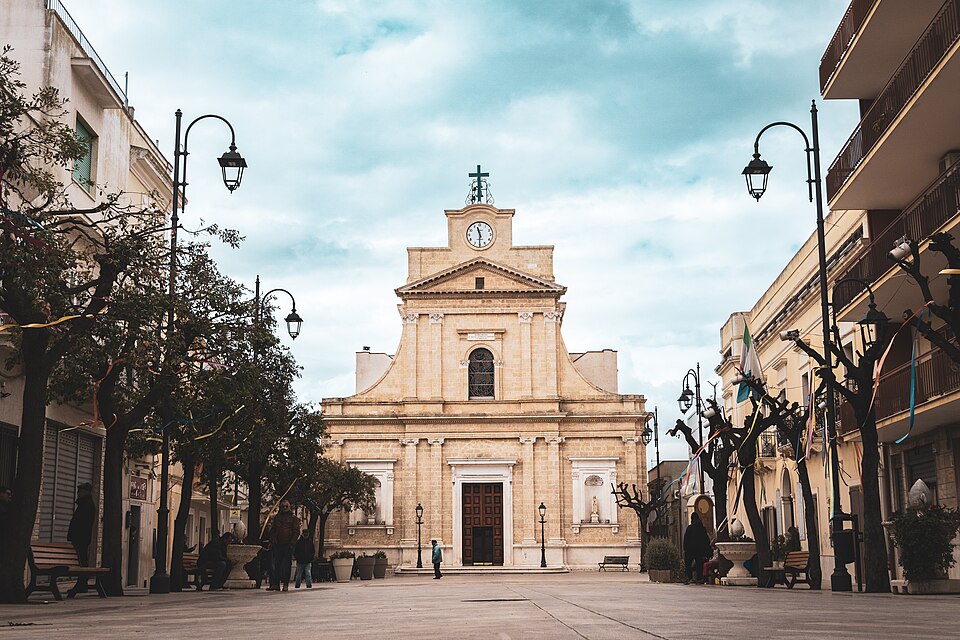
In the central square of Crispiano stands the Mother Church of Santa Maria della Neve, the town's main religious building and one of its most recognisable landmarks. Its façade is an interesting example of architectural harmony, with elements inspired by the Ionic and Doric orders that give it an elegant and monumental character.
Inside, the church houses sacred artworks and a precious Carrara marble altar. Dedicated to Crispiano's patron saint, it also contains a statue of Santa Maria della Neve, the focus of celebrations held on 5 August, one of the most deeply felt traditions in the local community.
Beyond its religious and artistic value, the Mother Church is an important reference point in the history of the town and an unmissable stop for anyone wishing to visit Crispiano and discover its identity and traditions.
Church of Santa Maria del Vallone and Crypt of the Abbey of Santa Maria
At the heart of the Vallone lies one of the most significant places in the history and origins of Crispiano: the Church of Santa Maria del Vallone, known by locals as the Old Church. It was built near the ancient caves where the first settlement of the town developed. The Ionic-Romanesque complex, probably dating back to the 16th century and built over earlier religious structures, contains the evocative crypt of the Abbey of Santa Maria di Crispiano, an ancient place of worship carved into the rock and dating back to the 11th century.
The crypt preserves a valuable cycle of Byzantine frescoes from the 11th and 12th centuries, depicting Christ Pantocrator, Saint Michael the Archangel, Saint Nicholas and the Madonna of Crispiano. They are evidence of the presence of the Basilian monastic tradition in the area. The church, once richly decorated with frescoes that have largely been lost, tells the story of the community's deep spiritual connection and the transition from the earliest settlements to the formation of the Crispiano community.
Church of San Francesco d'Assisi
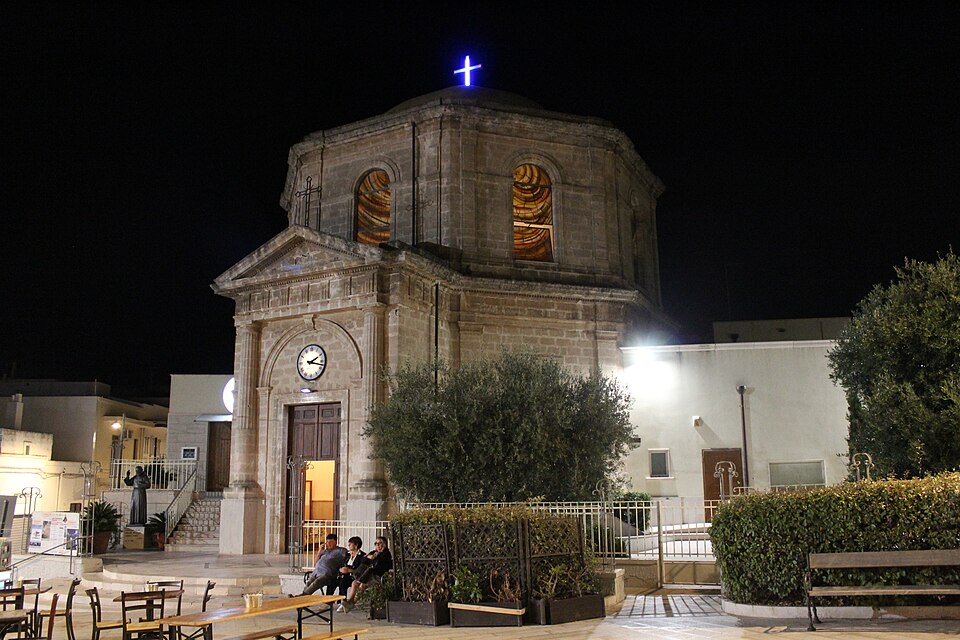
Among the most significant religious buildings to visit in Crispiano is the Church of San Francesco d'Assisi. Dating from the late nineteenth century, the building is distinguished by its Neoclassical architecture and imposing dome, which rises above an octagonal floor plan. The church was built in just two years thanks to the generous contribution of the local community and still represents an important reference point for the religious and social life of the town.
What to do in Crispiano - the Slow Active Tours proposal
Torre Cacace
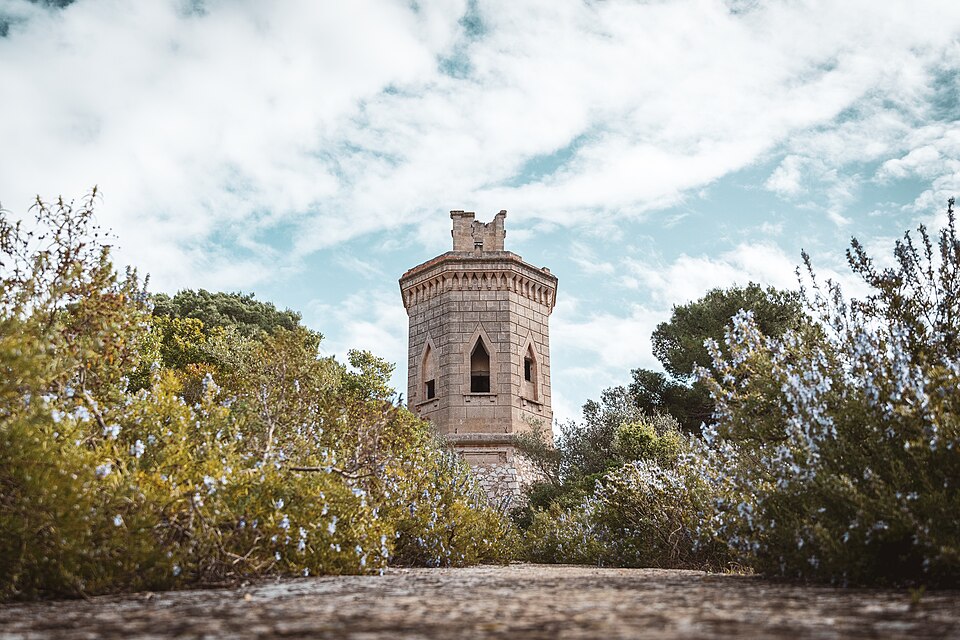
An undisputed symbol of Crispiano's identity is Torre Cacace, one of the town's most representative monuments. Built around 1873 at the request of engineer Carlo Cacace as a family mausoleum, the tower is distinguished by its octagonal plan and its height of approximately 30 metres. At the top, a reference to the Cacace family's maritime origins adds character to the monument, which dominates the landscape and offers a magnificent panorama over the Gulf of Taranto. After decades of abandonment and deterioration, Torre Cacace has been undergoing an important restoration and redevelopment project since 2025, aimed at returning one of the town's most precious symbols to the local community.
Rock Church and Crypt of San Giuliano in the Gravina di Triglie
In the evocative Gravina di Triglie lies the Crypt of San Giuliano (or San Cipriano), an ancient rock church probably dating from between the 9th and 13th centuries AD. It is evidence of the presence of religious communities and rock-cut settlements in the Crispiano area. Carved into the rock, the crypt features irregular chambers and a Latin altar. Traces of precious frescoes can still be seen, including depictions of Saint Julian with a Latin inscription, Saint Marina and the Virgin and Child.
Local tradition has added to the fascination of the site over time: holes can be seen at eye level on the faces of some of the frescoed saints, supposedly created because of the belief that a treasure was hidden there.
The small Church of San Michele Arcangelo stands above an ancient cave dwelling, within an evocative rock-cut village that developed in the Gravina di Triglie, a canyon known as the Via Cava, which once connected the communities of Crispiano and Statte.
Reading this article and already looking forward to visiting Crispiano?
Discover our travel proposals and set off on your next adventure!
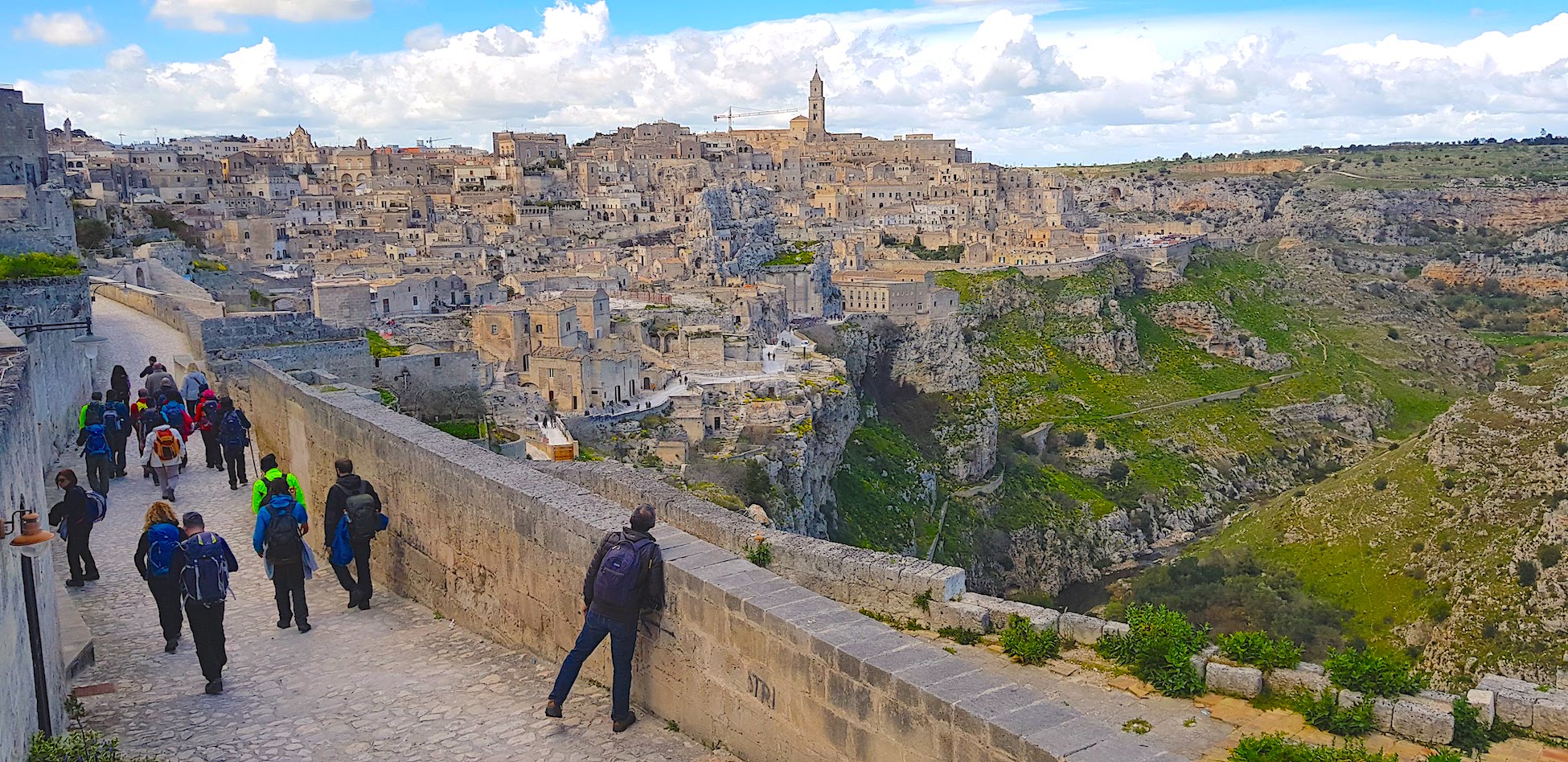
Via Ellenica through the Terra delle Gravine
9 days from the Sassi of Matera to Martina Franca
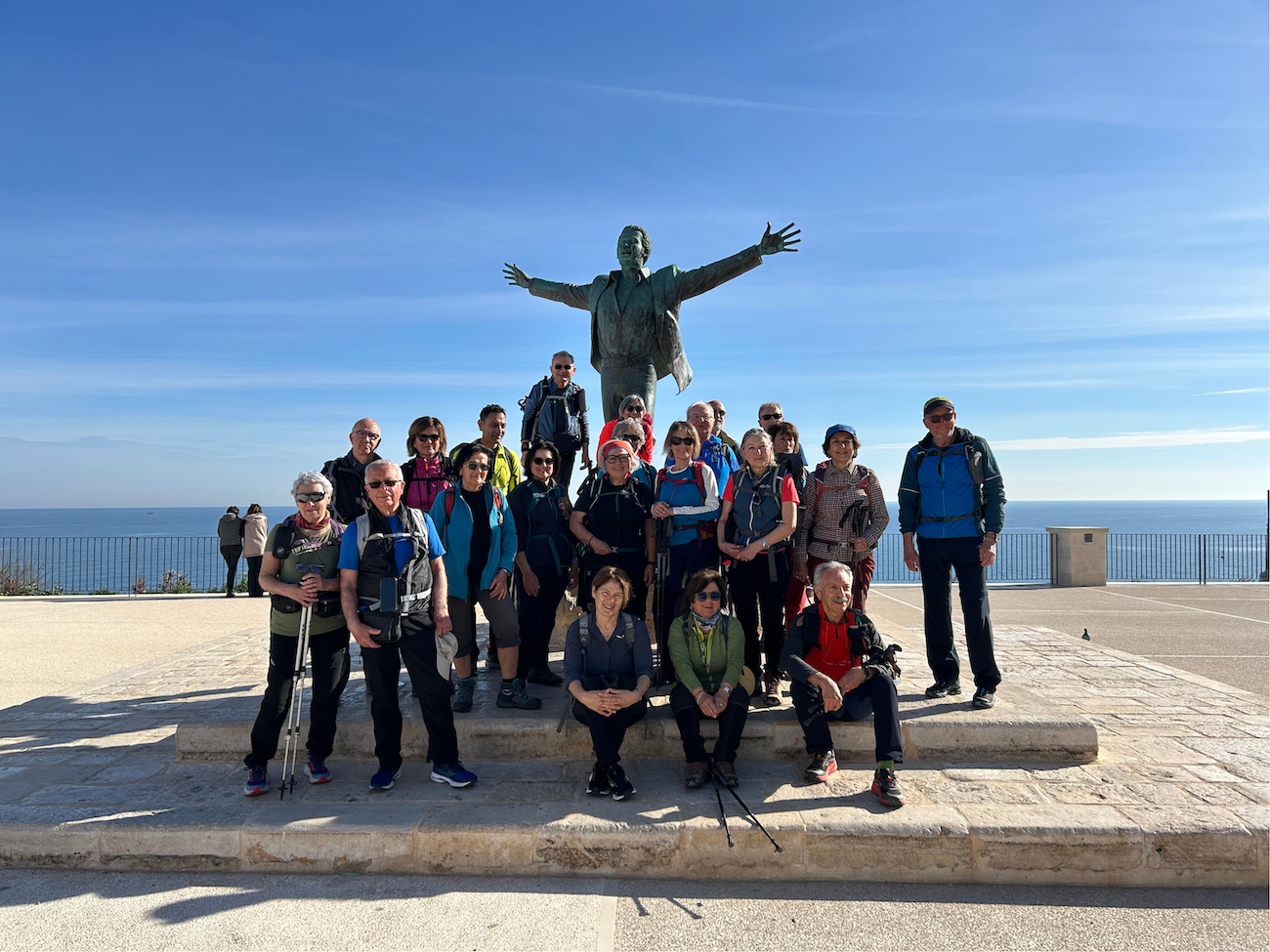
Walking the Two Seas Route
from Polignano a Mare to Taranto
Festivals and Popular Celebrations in Crispiano
Crispiano's popular celebrations reveal the authentic soul of the town, bringing together devotion, food and moments of community. Among the most deeply felt events are the religious celebrations dedicated to the saints and to the patron saint Santa Maria della Neve, celebrated on 5 August, when the streets of the town centre come alive with processions, music and traditions passed down through generations.
Among the most popular food events is the Sagra del Fegatino, held in July and dedicated to one of the symbols of local cuisine. Every year, the event attracts visitors with stands offering traditional products, music and festive entertainment.
In recent years, the Festival delle 100 Masserie has also helped promote Crispiano's rural identity, celebrating the connection between the area, farming culture, local flavours and the heritage of the ancient masserie.
These events offer an opportunity to experience Crispiano through its flavours, traditions and the warm hospitality of its community.
Typical Dishes of Crispiano
The cuisine of Crispiano tells the story of a land closely connected to agriculture and its ancient traditions. Among the area's signature products are extra virgin olive oil, cheeses and mozzarella, wine and the distinctive yellow and red cherry tomatoes, recognised as a Slow Food Presidium and an authentic expression of local biodiversity.
Alongside these traditional products, the local culinary heritage preserves simple dishes rich in history, such as f’cazzedd (ficazzelle), fritters made with Senatore Cappelli durum wheat semolina flour and served with cured meats or yellow and red “scattarisciato” tomatoes (pressed tomatoes); Pane del Brigante, a soft leavened bread enriched with local ingredients such as raisins, almonds, dried figs and aromatic herbs. Dedicated to the brigand Pizzichicchio, its flavours preserve the memory of rural life and local traditions; and the famous fegatini (gnummariedde), a speciality deeply rooted in Crispiano's popular culinary culture. These genuine flavours tell the story of the town's identity and its strong connection between community, agriculture and traditional cooking.
Eating and Drinking in Crispiano
Here are some local recommendations:
Cucina e Bottega at Corso Vittorio Emanuele III, 59. Open for lunch only. In the heart of Crispiano, it is a place to rediscover traditional local flavours through genuine dishes and regional products. A small establishment dedicated to Puglian cuisine, where quality and simplicity come together.
Tutto buono at Via Monte Calvario, 89. A reference point for anyone who loves the genuine flavours of traditional cuisine. A place to find typical products, local specialities and gastronomic offerings based on quality and simplicity.
È tempo di brace at Via Foggia, 61. A butcher's shop offering Crispiano's traditional specialities, from selected meats to typical grilled preparations. A place to rediscover the authentic flavours of Puglian cuisine.