
Anyone who thinks of Taranto simply as an industrial city is in for a surprise. Taranto, ancient Taras, is in fact one of the most important cities of Magna Graecia.
Visiting Taranto means immersing yourself in more than 2,500 years of history, wandering through atmospheric alleyways, crossing bridges that connect two seas, and discovering castles, museums and neighbourhoods where time seems to have stood still.
According to historical tradition, Taranto was founded by the Spartans in 706 BC.
Greek mythology, however, attributes its origins to Taras, son of the god Poseidon, who is said to have arrived on the shores of Taranto riding a dolphin and holding a trident, just as depicted in the city's coat of arms.
The city of the two seas has a unique charm, where history, the sea and local traditions come together to create a rich and authentic identity.
Taranto owes much of its character to its deep connection with the Mar Grande and Mar Piccolo, which have shaped its landscape and influenced everyday life for centuries. The sea has always been at the heart of the city, not only because of fishing and maritime activities, but also because of the presence of the Naval Maritime Arsenal, one of the most important institutions in the history of Italian naval and industrial development, which helped shape the modern face of the city.
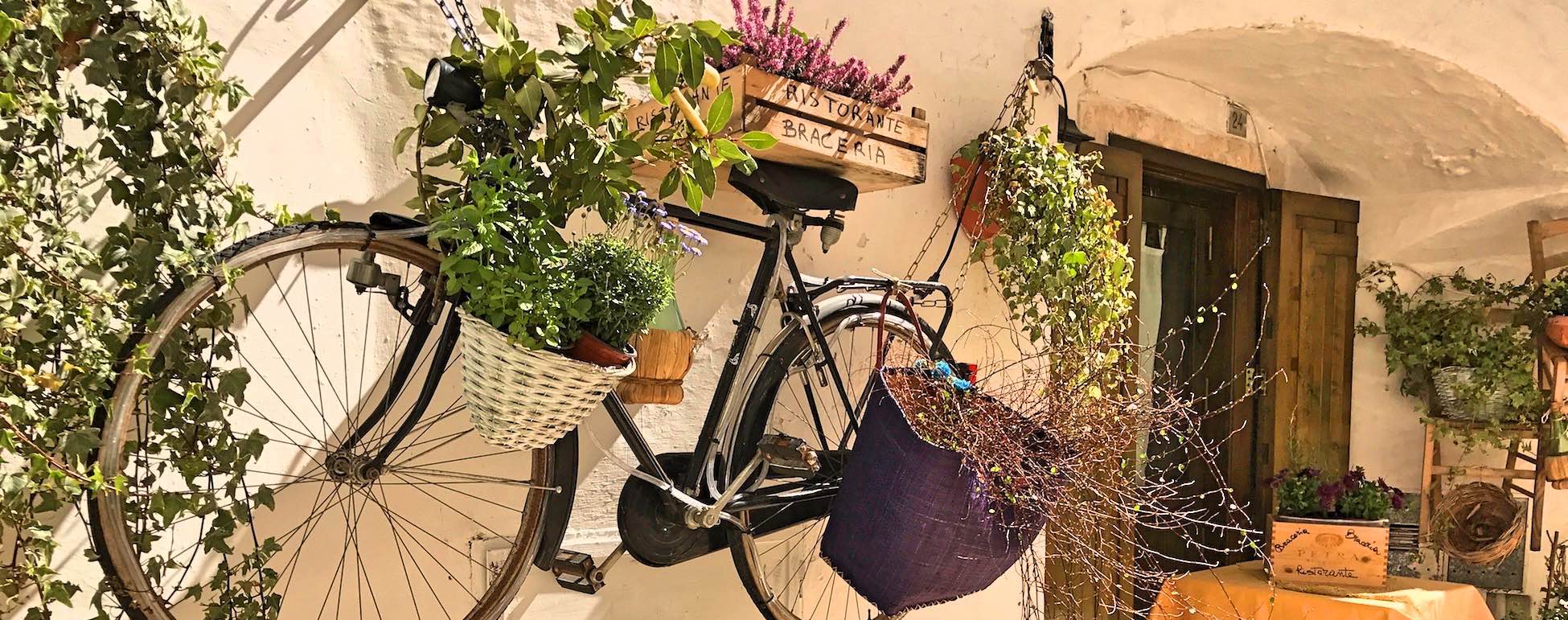
Taranto is also an ideal destination to explore on foot or by bicycle, at a pace that allows you to notice the details, scents and encounters that can easily be missed when travelling by car.
What to see in Taranto
Taranto is a city full of surprises, where every corner tells a story spanning more than two thousand years. Walking through the narrow streets of the Old Town, you will come across the majestic Aragonese Castle, the Cathedral of San Cataldo, the remains of the Doric Temple and the famous Swing Bridge, one of the city's most recognisable landmarks. A visit to the National Archaeological Museum MArTA reveals the treasures of ancient Taras, one of the most important cities of Magna Graecia. Taranto was also the birthplace of distinguished figures such as Archytas, philosopher, mathematician and strategist, and Aristoxenus, philosopher and music theorist. But Taranto is also about tradition: its deep connection with the sea, fishing, local cuisine and ancient religious celebrations make it an authentic city where the past continues to live in the present.
Old Town
The Old Town stands on an island, the ancient acropolis, connected to the mainland by the Swing Bridge and the Stone Bridge. Walking through its narrow streets means stepping into history, surrounded by historic palaces, maritime traditions and atmospheric views.
Its distinctive urban fabric dates back to the Byzantine period and is characterised by the pittaggi, historic neighbourhoods made up of a dense network of alleyways and small squares that still preserve the atmosphere of Taranto of the past.
This is where the famous Holy Week rituals take place, among the most evocative in Italy, and where you can experience the city's most authentic soul.
Today, the historic centre is at the heart of an important programme aimed at restoring and promoting its architectural and cultural heritage.
Doric Temple Columns
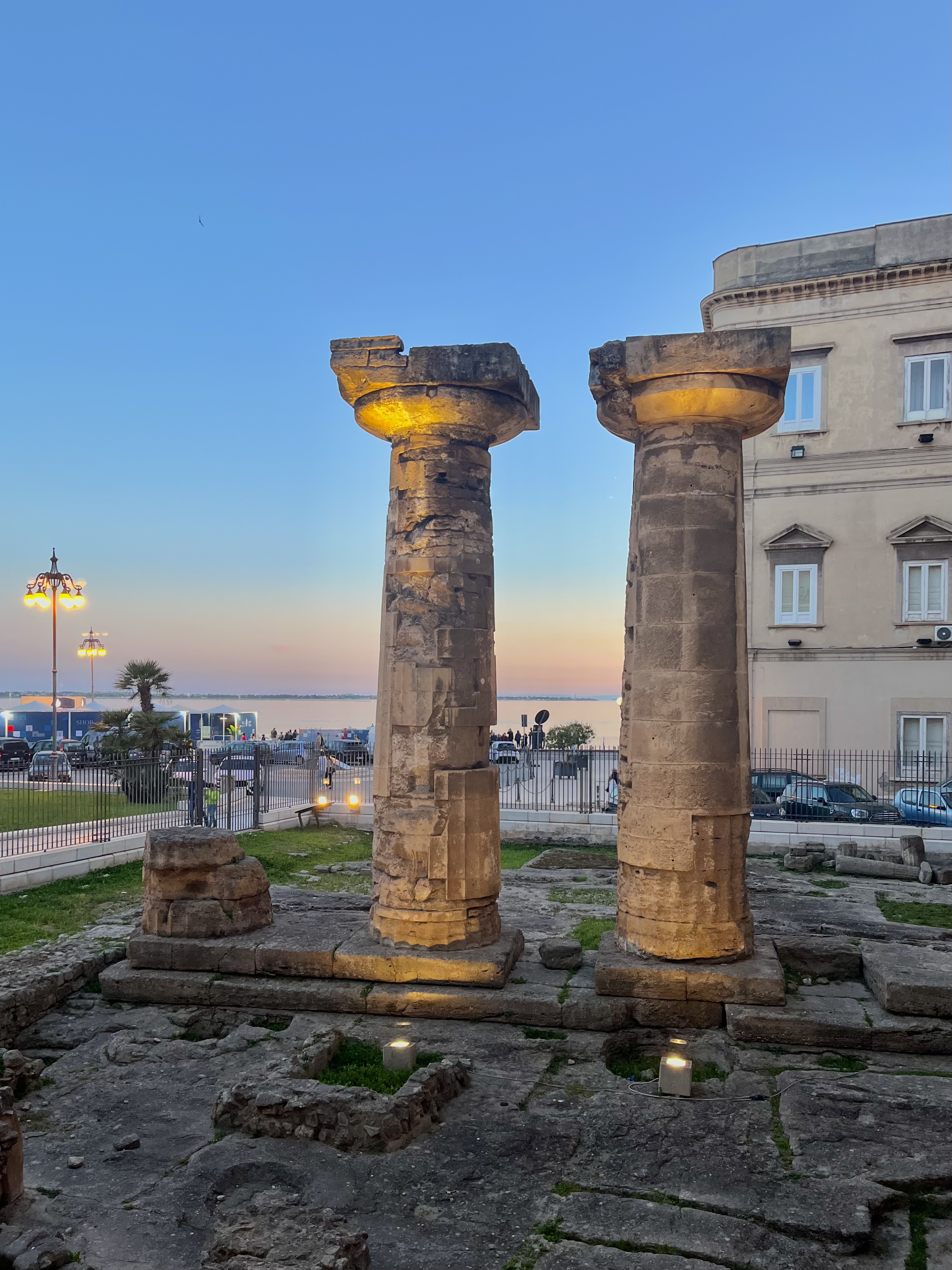
The Doric Temple, the oldest known place of worship in Magna Graecia, dates back to the first half of the 6th century BC. Today, only two majestic columns remain, brought to light during the excavations and demolitions carried out in the 19th century, which revealed the remains of the ancient building. Although its dedication has never been definitively established, the temple is believed to have been dedicated either to Poseidon, god of the sea and protector of sailors, or to Persephone, goddess of fertility and the cycle of nature, whose cult was deeply rooted in Magna Graecia.
Swing Bridge
The Swing Bridge is one of Taranto's most iconic landmarks, connecting the Old Town with the New Town. Inaugurated in 1887 and dedicated to Saint Francis of Paola, it was built together with the navigable canal linking the Mar Grande and Mar Piccolo. At the time, it was considered a remarkable feat of engineering: its two movable sections opened using an innovative hydraulic system to allow ships to pass through.
Even today, the bridge regularly opens to allow vessels bound for Mar Piccolo to pass, creating one of the city's most characteristic sights.
If you choose to visit Taranto in May, you can witness one of the city's most deeply felt celebrations: the San Cataldo procession on the sea, dedicated to Taranto's patron saint. On this occasion, the famous Swing Bridge opens to allow the patrol boat carrying the saint's statue to pass, followed by dozens of fishing boats and other vessels decorated for the celebration. It is a unique spectacle that reveals the city's maritime soul and its deep connection with the sea and its ancient traditions.
Cathedral of San Cataldo
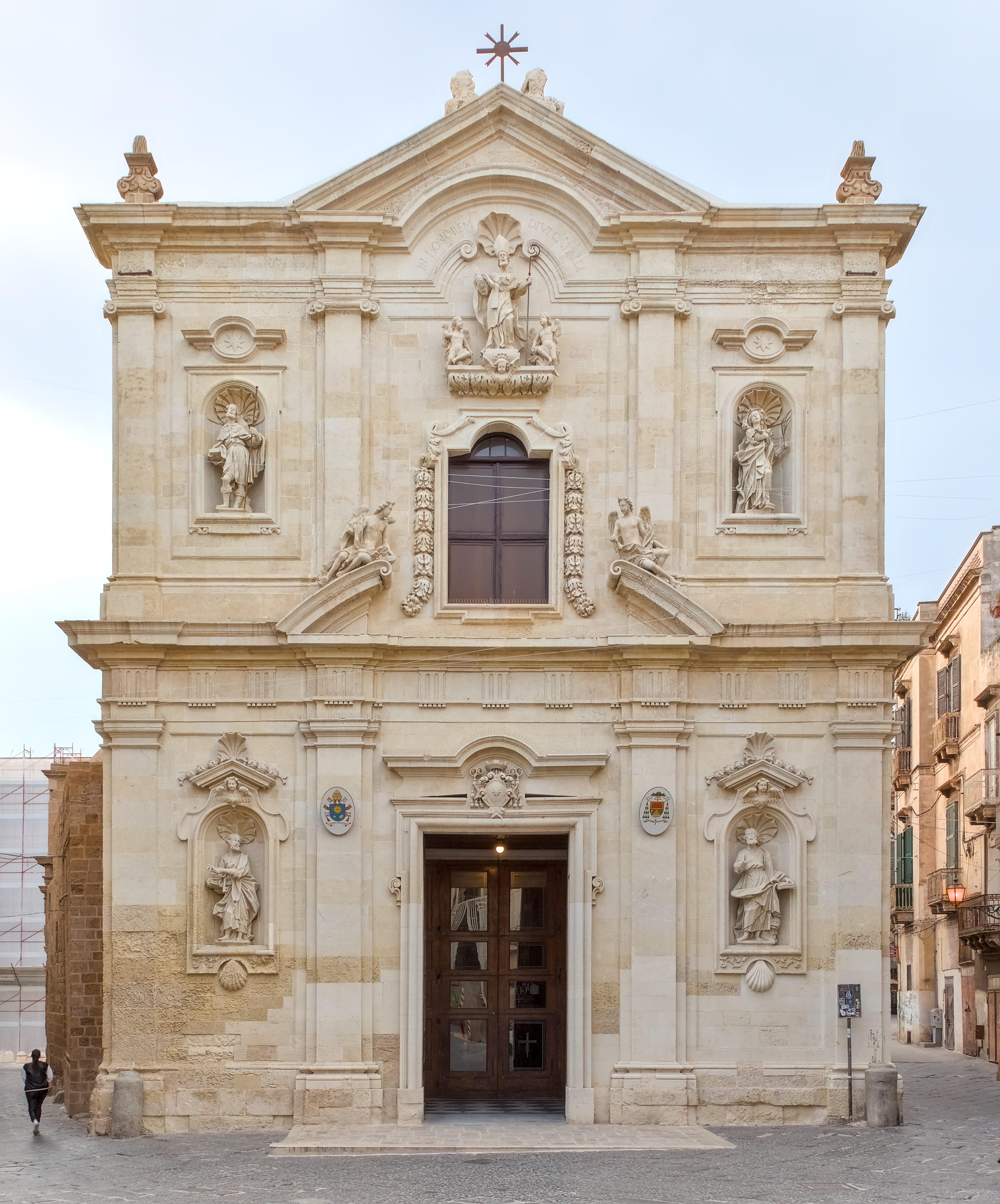
At the heart of Taranto's Old Town stands the Cathedral of San Cataldo, the oldest cathedral in Puglia and one of the city's most important landmarks. Dedicated to Taranto's patron saint, it is an unmissable stop for anyone wishing to discover the city's history and artistic heritage.
The Baroque façade conceals a building with medieval origins, transformed and enriched over the centuries. Inside, a fascinating mix of architectural styles tells the long story of the cathedral: Romanesque, Byzantine and Baroque elements coexist in harmony, creating a truly atmospheric setting.
The real masterpiece is the Chapel of San Cataldo, one of the finest examples of Baroque art in Puglia. It is decorated with polychrome marble, frescoes and extraordinary sculptures by Giuseppe Sanmartino, the same artist who created the famous Veiled Christ in Naples. The chapel also houses the relics of the city's patron saint.
Before leaving, take a moment to admire the remains of the medieval floor mosaic, one of the cathedral's most fascinating surviving features. Among human figures, animals and symbolic scenes, an allegory of Alexander the Great stands out, surrounded by images representing human virtues and vices.
Co-Cathedral of Gran Madre di Dio
Among Taranto's most striking buildings is the Co-Cathedral of Gran Madre di Dio, designed by Gio Ponti and inaugurated in 1970.
It is considered one of the masterpieces of contemporary Italian religious architecture. Its modern style, clean lines and skilful use of light create bright and atmospheric interiors.
The feature that makes it instantly recognisable is its large sail-shaped façade, a clear reference to Taranto's relationship with the sea. Reflected in the pools of water in front of the church, it creates a particularly striking scene. The interiors also evoke the maritime world, with colours and details that express the city's identity in an original and contemporary way.
Things to do in Taranto - Slow Active Tours' suggestion
Taranto is history, culture and traditions, but our journey of discovery is only just beginning!
Museums and culture
If you want to discover Taranto's history, an essential stop is the MArTA, the National Archaeological Museum. Considered one of Italy's most important archaeological museums, it houses an extraordinary collection of artefacts from Magna Graecia, including ceramics, sculptures, mosaics and the famous Gold of Taranto: authentic masterpieces of ancient goldsmithing.
The Gold of Taranto has made the museum famous internationally, thanks to prestigious exhibitions around the world and appearances at events such as EXPO Shanghai and EXPO Milan.
Visiting MArTA is one of the best ways to understand the city's millennia-old history and why Taranto was considered one of the most important colonies of Magna Graecia.
For anyone interested in history and archaeology, the Greek Necropolis of Taranto is another fascinating stop. It is the largest funerary area of ancient Taras that can currently be visited, with tombs dating from different periods of Magna Graecia offering an insight into the customs and daily life of a city that flourished more than two thousand years ago.
Among the most interesting sites are the Tomb of the Athletes on Via Crispi, famous for its rich funerary objects, and the archaeological area on Via Marche, where numerous burials and evocative chamber tombs still preserve traces of their original decorations.
The Naval Maritime Arsenal is one of Taranto's landmarks and tells the story of the city's deep connection with the sea and the Italian Navy. Inaugurated in 1889, it was for more than a century an important centre for the construction and maintenance of ships.
Inside is the M.O.S.A. (Historical Craft Exhibition), a small museum that traces the history of the Arsenal through photographs, documents, ship models and original artefacts. It is an interesting stop for anyone who wants to discover a lesser-known side of Taranto and explore its maritime and industrial heritage.
The Aragonese Castle, also known as Castel Sant'Angelo, is one of Taranto's most iconic landmarks. Located at the entrance to the Old Town, it was rebuilt at the end of the 15th century on the orders of Ferdinand I of Aragon. The castle is characterised by four imposing circular towers that still dominate the cityscape.
Over the centuries, it served various purposes, from defensive fortress to prison and barracks. Today it is home to the Italian Navy and can be visited on guided tours that explore the history of the castle and the city. Its position overlooking the navigable canal and next to the famous Swing Bridge makes it one of the most atmospheric and photographed places in Taranto.
Authentic experiences
One of the most memorable experiences in Taranto is offered by Jonian Dolphin Conservation, a non-profit organisation dedicated to researching and protecting cetaceans in the Ionian Sea. On board its catamarans, visitors can join real marine expeditions in search of dolphins and other marine species, enjoying the unique opportunity to become “researchers for a day” and actively participate in observation and data collection. It is a fascinating experience combining discovery with environmental awareness.
The heart of these activities is KETOS – the Euro-Mediterranean Centre for the Sea and Cetaceans, the headquarters of Jonian Dolphin Conservation located in the historic Palazzo Amati in the Old Town. The centre is dedicated to research, public outreach and environmental education, offering an opportunity to learn more about the biodiversity of the Ionian Sea and Taranto's deep relationship with its waters.
In 2025, Taranto added another important chapter to its relationship with the sea with the creation of the San Paolo Dolphin Refuge, the first marine refuge in Europe dedicated to the care and rehabilitation of dolphins from zoological facilities. Located around San Paolo Island in the Gulf of Taranto, the innovative project combines research, animal protection and ecotourism, strengthening the city's role as a centre for understanding and protecting the marine environment.
For sports enthusiasts, 2026 will be an important year for Taranto. From 21 August to 3 September, the city will host the XX Mediterranean Games, one of the major international sporting events dedicated to countries bordering the Mediterranean. Thousands of athletes from 26 nations are expected to compete in 28 sports, turning Taranto and other towns in Puglia into a major sporting stage. In particular, the scenic Itria Valley will host road cycling events.
The event is about much more than sport. The Games are also an opportunity for urban regeneration and the enhancement of the local area, with the renewal of sports facilities, infrastructure and public spaces. For visitors, it will be an opportunity to experience the international atmosphere of the event while discovering Taranto's historic heritage, coastline and culinary traditions, bringing together sport, culture and tourism.
Nature and surroundings
Taranto also offers beautiful places where nature, the sea and archaeology come together. Among the most interesting areas is the Palude La Vela Regional Oriented Nature Reserve, an oasis on Mar Piccolo rich in biodiversity and ideal for birdwatching and nature lovers.
A few kilometres from the city lies the Saturo Archaeological Park, a green area overlooking the sea where you can discover the remains of an ancient Roman villa surrounded by beaches, nature and historical evidence.
In the Mar Grande, the Cheradi Islands emerge from the sea, including San Pietro Island and San Paolo Island, the latter preserving the remains of a Napoleonic fort. These small havens can be reached by boat, while the area's waterways include the Galeso River and the Tara River, places closely connected to the history, mythology and culture of the Taranto area.
An itinerary to discover a more authentic side of Taranto, where the sea, archaeology and nature coexist in a unique balance.
Reading this article and already looking forward to visiting Taranto?
Discover our travel proposals and set off on your next adventure!
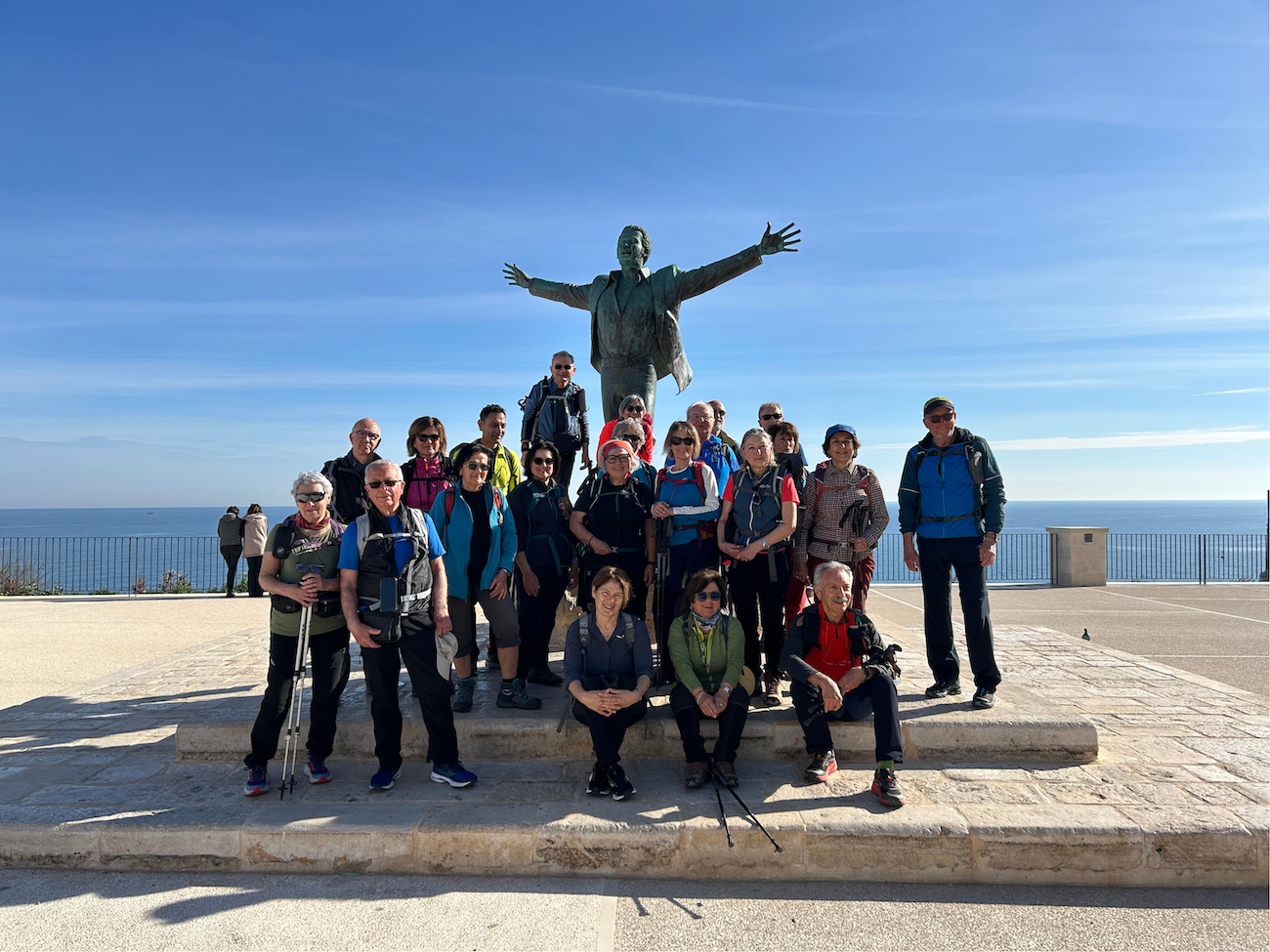
Walking the Two Seas Route
from Polignano a Mare to Taranto
Festivals and Popular Celebrations in Taranto
Feast of San Cataldo
Every year in May, Taranto comes alive to celebrate San Cataldo, its beloved patron saint, in an event that brings together spirituality, history and popular traditions. The origins of the devotion go back to Saint Cataldo, an Irish-born bishop who, according to tradition, arrived in Taranto during his evangelising mission and later became the city's patron saint.
The celebration offers a glimpse into the most authentic soul of Taranto, where religious rituals intertwine with the fascination of the sea and the city's collective memory. Among the oldest traditions is “lu preggiu” (the privilege), a ceremony during which the statue of the saint is symbolically entrusted to the Mayor, renewing the bond between San Cataldo and the Taranto community. It represents the honour granted to the city of safeguarding the saint during the days of the celebration.
Another highly anticipated moment is the procession on the sea: the statue of the patron saint is placed aboard a Navy vessel and carried across the Mar Grande and Mar Piccolo, followed by numerous boats and a large crowd of worshippers. Passing through the navigable canal, with the Swing Bridge opening and fireworks illuminating the Aragonese Castle, creates one of the most spectacular moments of the entire celebration.
Visiting Taranto during the celebrations of its patron saint offers a unique opportunity to understand the deep connection between the city and the sea that surrounds it.
Connected to this popular devotion is also the legend of San Cataldo's ring. According to the story, during a violent storm, the saint threw his pastoral ring into the sea as an act of faith, managing to calm the waters. At the point where the ring is said to have sunk, freshwater springs began to emerge from the sea: the famous citri, unique natural phenomena that have fuelled the city's mystery and fascination for centuries and are said to contribute to the exceptional flavour of Taranto's black mussels.
Feast of Sant'Anna
Another important celebration takes place on 26 July, when Taranto celebrates the Feast of Sant'Anna, an ancient tradition deeply connected with the Old Town and its history.
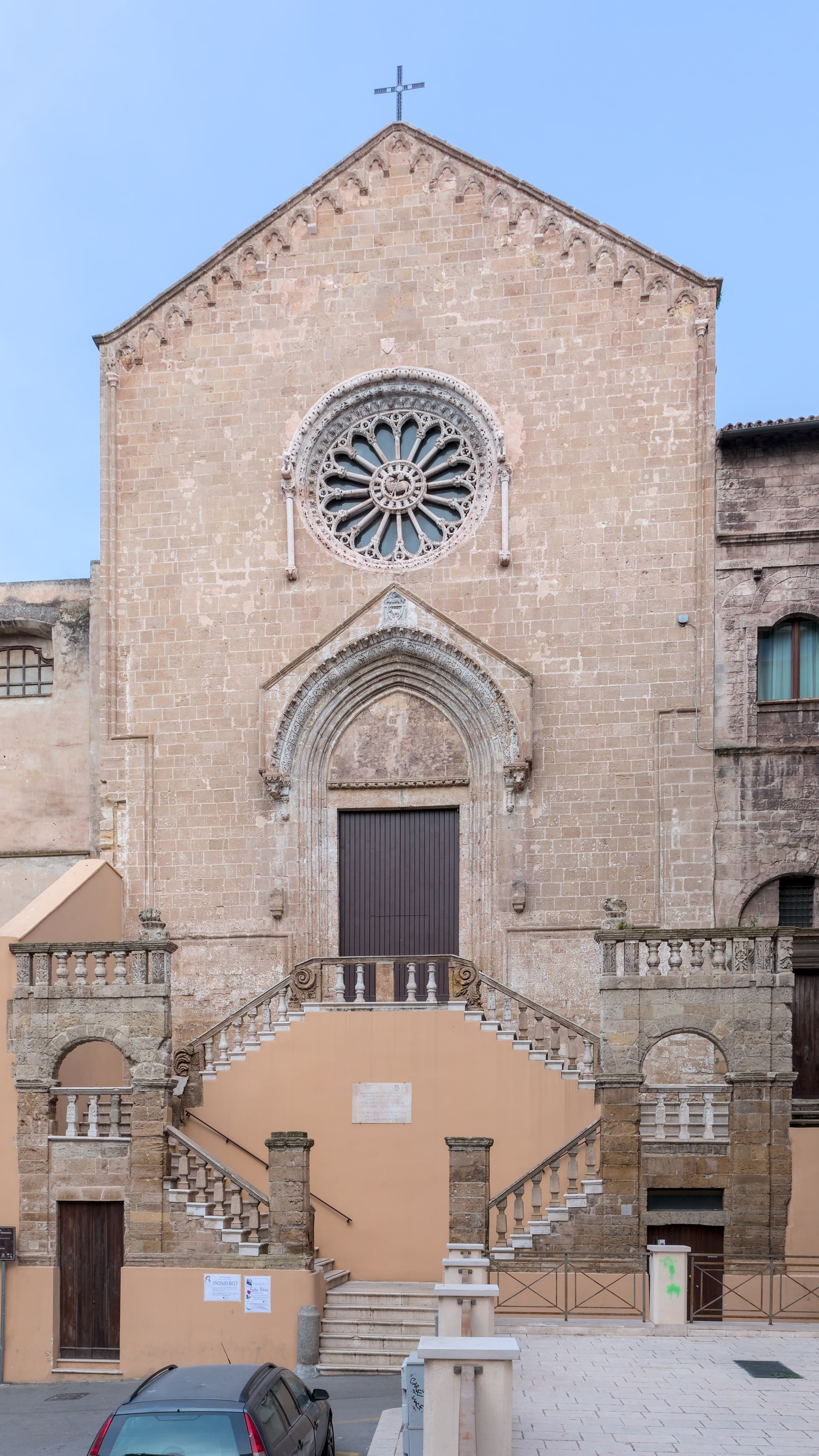
Here stands the small church dedicated to the saint, built in 1914 on earlier medieval remains and affectionately known by the people of Taranto as the “House of the Grandparents”, a symbolic place of devotion and reflection.
Sant'Anna, mother of the Virgin Mary and grandmother of Jesus according to Christian tradition, has been venerated for centuries as the protector of mothers, expectant women and families.
In the Old Town, popular devotion is expressed through the figure of “Mamma Sand’Anne”, to whom generations of people from Taranto have turned for protection and blessings.
The celebration also involves Saint Joachim, her husband and Mary's father, with a procession through the streets of the island accompanied by the historic Confraternity of Our Lady of Sorrows, which also plays a central role in Taranto's Holy Week rituals. A particularly meaningful moment is the stop at the Cathedral Basilica, where the Jubilee of Grandparents is renewed, a celebration dedicated to older people, children and expectant mothers, highlighting the importance of family bonds and the transmission of traditions between generations.
Holy Week Rituals
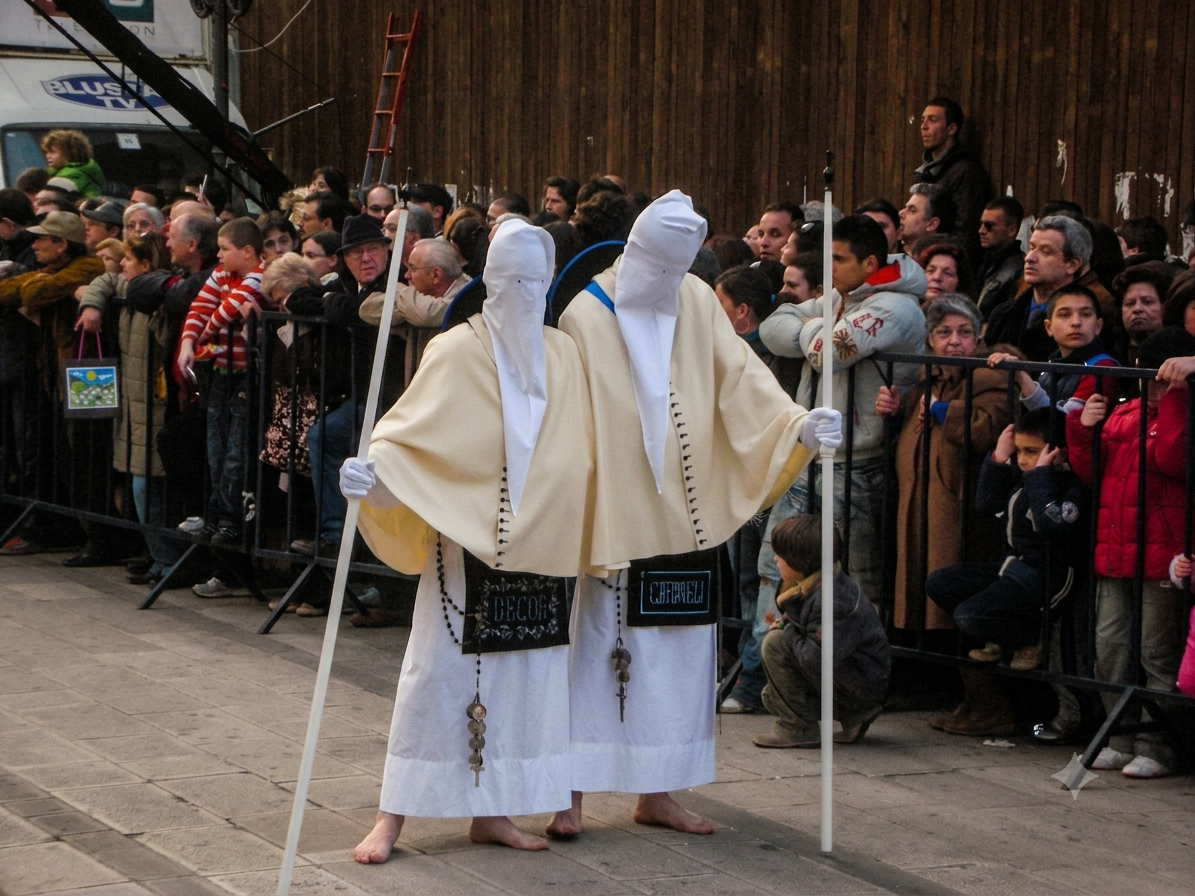
Taranto's Holy Week rituals are among the city's oldest and most evocative traditions, bringing together faith, history and popular culture. Their origins date back to the second half of the 16th century, during Spanish rule, and derive from ancient Aragonese customs. The ritual begins on Holy Thursday with the departure of the Perdoni from the Church of the Carmine: hooded, barefoot members of the confraternity dressed in traditional white robes slowly make their way through the streets of the Old Town to visit the “sepulchres”. Their procession is accompanied by the troccole, ancient wooden instruments with a distinctive sound that mark the different stages of the ritual and contribute to its unique atmosphere.
On the night between Holy Thursday and Good Friday, the Procession of Our Lady of Sorrows leaves from the Church of San Domenico, while on Good Friday the Procession of the Mysteries begins at the Church of the Carmine. For around fifteen hours, statues depicting the Passion of Christ are carried through the streets of Taranto on the shoulders of members of the confraternities, accompanied by funeral marches and the famous nazzecata, the slow, rhythmic swaying step that characterises their journey.
Visiting Taranto during the Holy Week rituals means experiencing something intense and timeless, where silence, music and centuries-old traditions reveal the deepest soul that Taranto still preserves among the narrow streets of its Old Town.
Typical Dishes of Taranto
Food in Taranto is also deeply rooted in local traditions and religious culture. Walking through the streets of the Old Town during the festive season, you can taste pettole or Sanacchiùdere, traditional fried sweets associated with Christmas in Taranto. Tradition says that the last of these little treats should be eaten on 10 May, on the feast of San Cataldo, the city's patron saint.
But the undisputed queen of Taranto's tables is the black mussel: eaten raw, arracanata, with tubettini pasta or prepared in countless other ways, it represents the true essence of Taranto's culinary identity. Mussel farming has a very long history in Taranto, dating back as far as the 16th century, and since 2022 the product has been recognised as a Slow Food Presidium, helping protect a centuries-old tradition and a unique local product.
Alongside mussels, Taranto's cuisine celebrates the fresh catch of the Mar Piccolo and Mar Grande, with species such as red mullet, sea bream, dentex, cuttlefish, octopus and prawns taking centre stage in simple recipes designed to highlight the quality of the ingredients.
The cuisine of the surrounding countryside also features specialities such as chiangarèdde, the traditional Taranto-style orecchiette, and gnummarìdde, reflecting the meeting of sea and land flavours that makes Taranto's cuisine so distinctive.
Eating and Drinking in Taranto
Here are some local suggestions:
Pescheria Trattoria del Pescatore at Piazza Fontana, 47. A historic fish market and restaurant in the heart of the Old Town, serving traditional seafood cuisine prepared with the catch of the day. Specialities include mixed fried seafood, linguine Taranto-style, tubettini with mussels, fish soups and raw seafood.
Ristò Fratelli Pesce at Via Porto, 18. A restaurant focused on showcasing local seafood and Taranto's culinary traditions with a contemporary approach. The menu includes raw seafood, grilled cuttlefish, octopus, spaghetti with clams and other fish dishes prepared with exceptionally fresh ingredients.
La Locanda dei Briganti at Via Duomo, 262. A charming restaurant in the Old Town specialising mainly in traditional Puglian and Taranto-style meat dishes. The menu includes grilled meats, traditional pasta dishes, local cured meats and cheeses, offering an alternative to seafood in a rustic and welcoming setting.