
There are journeys that simply lead to a destination. And then there are journeys that become a profound experience, marked by a continuous flow of ever-changing landscapes and views, silence, encounters, and memory. The Cammino Celeste is one of these.
It is an itinerary that crosses Friuli Venezia Giulia and connects three different countries, following ancient pilgrimage routes and old paths, through mountains, cultivated hills, open plains, and lagoons suspended between sea and land.
It consists of three routes that originate in places of particular significance for the history and tradition of these lands:
- Aquileia, in Italy, where the Gospel was first announced;
- Brezje, the most important place of devotion to the Mother of God in Slovenia;
- Una, a center of great importance in the history of Carinthia and the cultural and religious identity of Central Europe.
The three routes converge in Camporosso, then ascend Monte Lussari, whose summit reaches 1,760 m above sea level.
Walking the Cammino Celeste means entering a landscape that constantly changes shape and color: the dense green of forests, the golden vineyards of the Collio, the wide breath of the Friulian plain, and the endless play of light over the lagoon of Grado and the Adriatic Sea.
But the Cammino Celeste is not only nature. It is a journey through history, spirituality, and the deepest identity of a borderland where different cultures have met for centuries.
What the Cammino Celeste is
The Cammino Celeste is a spiritual and cultural itinerary that links sanctuaries, basilicas, and places of worship across Friuli Venezia Giulia, Austria, and Slovenia. It was born as a pilgrimage route to the Sanctuary of Monte Lussari, in the heart of the Julian Alps, but over time it has become a network of paths crossing the entire region down to the sea.
Each variant of the route preserves the same spirit: an invitation to slow down, observe, and experience the territory step by step. Among the most significant places encountered are Cividale del Friuli, Castelmonte, Cormons, Aquileia, Grado, the island of Barbana, Monte Lussari, and the sanctuary of Sveta Gora in Slovenia.
These are not just daily destinations, but true pieces of a puzzle to be carefully crossed and preserved, because every detail tells a story.
The Cammino Celeste, both in its standard form and in its special reverse route, is accessible from June to September. During the rest of the year, some stages are not passable due to snow covering more than half of the trail.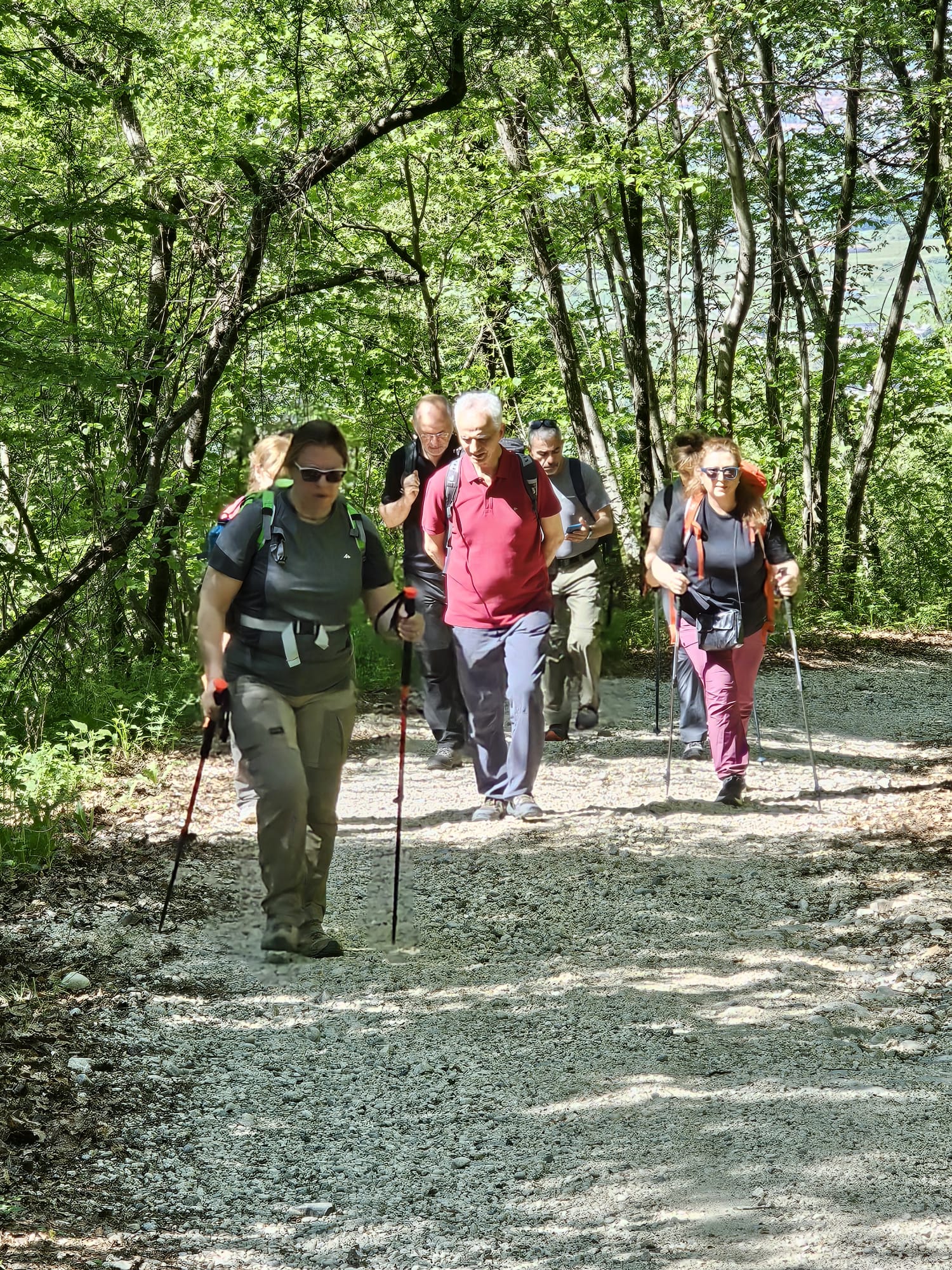
The italian branch of the Cammino Celeste
One of the most striking aspects of the Cammino Celeste is its constantly changing character, as if each day of walking belonged to a different world.
The Julian Alps and the forests of northern Friuli
In the initial section of the Cammino Celeste in Friuli Venezia Giulia, the landscape gradually rises, becoming more rugged, silent, and deeply natural. This is the area of the Julian Alps and the forests of northern Friuli, where the path changes character: from gentle cultivated hills to narrow valleys, dense forests, and trails that seem to preserve a more ancient and intimate dimension of the journey.
Here Friuli Venezia Giulia reveals its wildest face, but also one of its most spiritual. It is a land of deep silence, broken only by the sound of water and the wind moving through the leaves. Stone houses, small sanctuaries, and scattered hamlets tell the story of a rural life still closely tied to the mountains and their traditions. The walk becomes more introspective: every ascent invites slowness, every curve opens unexpected views over the valley.
Approaching the border, the landscape becomes distinctly alpine. The Cammino Celeste enters its most mountainous section: fir forests, high pastures, and crisp air accompany the pilgrim’s steps. The Julian Alps rise ever more prominently, with peaks emerging suddenly behind the woods.
Nearby lies Malborghetto Valbruna, where nature dominates and villages appear embedded in green. It is a territory that invites silence, contemplation, and a deeper perception of the walk as an inner experience.
Higher up, the route reaches areas around the surrounding mountains, where the landscape becomes severe and spectacular. Rock walls, alpine meadows, and the peaks of the Julian Alps create an essential, almost primordial environment. In this breathtaking setting, the walker strongly perceives the connection with nature: wind, silence, and vast space become central elements of the experience.
The Collio and the Friulian plain: the softness of cultivated land
Among the most authentic experiences of the Cammino Celeste from Cividale del Friuli to Grado, the section crossing the Collio and the Friulian plain reveals the quietest and most surprising face of the region. The landscape changes gently, without breaks: vine-covered hills guide the walker toward a wide, luminous plain of fields, small villages, and secondary roads where time seems to slow down.
The journey takes shape around Cormons, one of the most charming towns in the Collio region. Arriving here means entering a land where wine, border culture, and quietness are part of the landscape itself. The gentle hills fade into neat rows of vines, old farmhouses, and small bell towers emerging from the green. Quiet squares and peaceful streets invite a slow pause, perhaps over a coffee or in one of the traditional taverns where Friuli’s authentic character is told.
Here nature does not impose itself; it accompanies. White roads run alongside vineyards, while silence is broken only by the wind or a distant tractor in the fields.
The pilgrim crosses one of Italy’s most renowned wine regions. Small family wineries, stone farmhouses, and signs of long agricultural tradition appear frequently. This section becomes a sensory journey: the smell of wet earth after rain, the shade of cypresses, sunlight filtering through the vines.
Then, almost without noticing, the landscape changes again. The rhythm of the seasons still defines daily life, and village taverns become genuine meeting places where travelers can taste local cuisine and hear stories of a region accustomed to welcoming those who pass through.
Light also changes gradually. Morning mist may cover the fields, creating suspended atmospheres; in the late afternoon, the sun turns agricultural plains golden, guiding the walk toward Aquileia, the natural gateway to the lagoon and the final arrival in Grado.
Perhaps this gradual transformation is the most memorable aspect: the Collio and the Friulian plain do not impress with spectacle, but win over slowly, step by step, with the quiet beauty that remains in memory long after the journey ends.
The lagoon of Grado and the island of Barbana: the breath of water
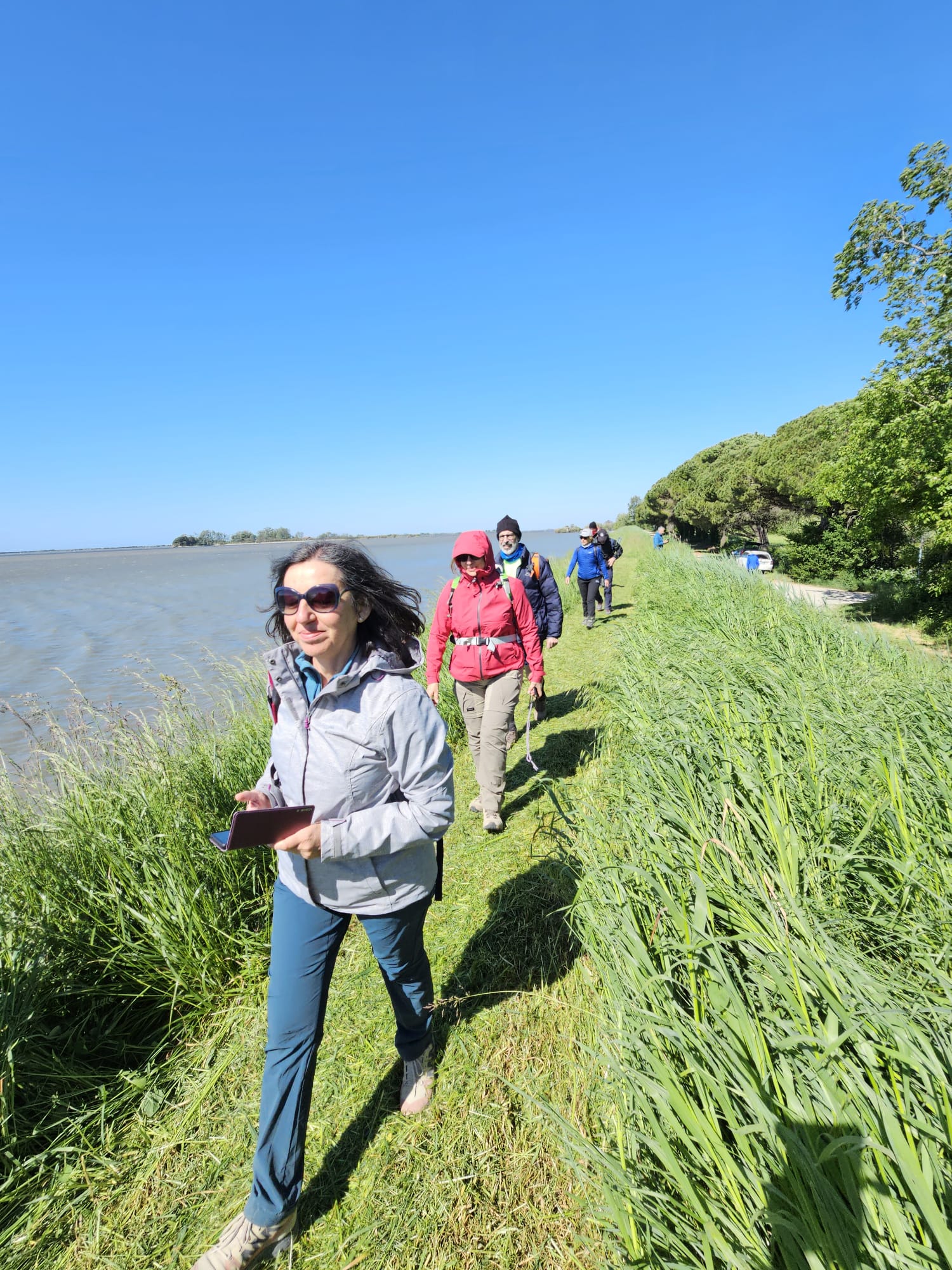
The final stretch leads into a completely different world. Land slowly dissolves into the lagoon of Grado, where water and sky merge into a shifting horizon. Reeds, silver reflections, small boats, and deep silence accompany the traveler toward the Adriatic Sea. Arrival at Barbana is an experience beyond words, a place that must be lived to understand its sense of peace.
The small sanctuary, surrounded by water, appears suspended in time, where silence becomes a tangible presence. Here the journey finds its natural conclusion, between spirituality, nature, and light.
A journey through the layered history of Friuli Venezia Giulia
The Cammino Celeste is also a path through the memory of a complex and layered land.
Cividale del Friuli: between Lombards and the Middle Ages
Cividale del Friuli welcomes travelers with its ancient and intimate atmosphere. Lombard origins are still visible in its architecture, museums, and the famous Lombard Temple, a masterpiece of early medieval European art.
Walking its streets means entering another time, where history and daily life coexist. Founded by Julius Caesar as Forum Iulii, it is today one of the most authentic gems of Friuli. The historic center reveals the quiet elegance of a border city: medieval buildings, silent alleys, and the green waters of the Natisone River beneath the Devil’s Bridge.
Here the Cammino Celeste immediately becomes intimate. The first hours among cobbled streets invite slowness. Cividale is also where the landscape begins to shift: mountains remain behind, while soft hills and vineyards open ahead.
Aquileia: the great Roman and Christian city
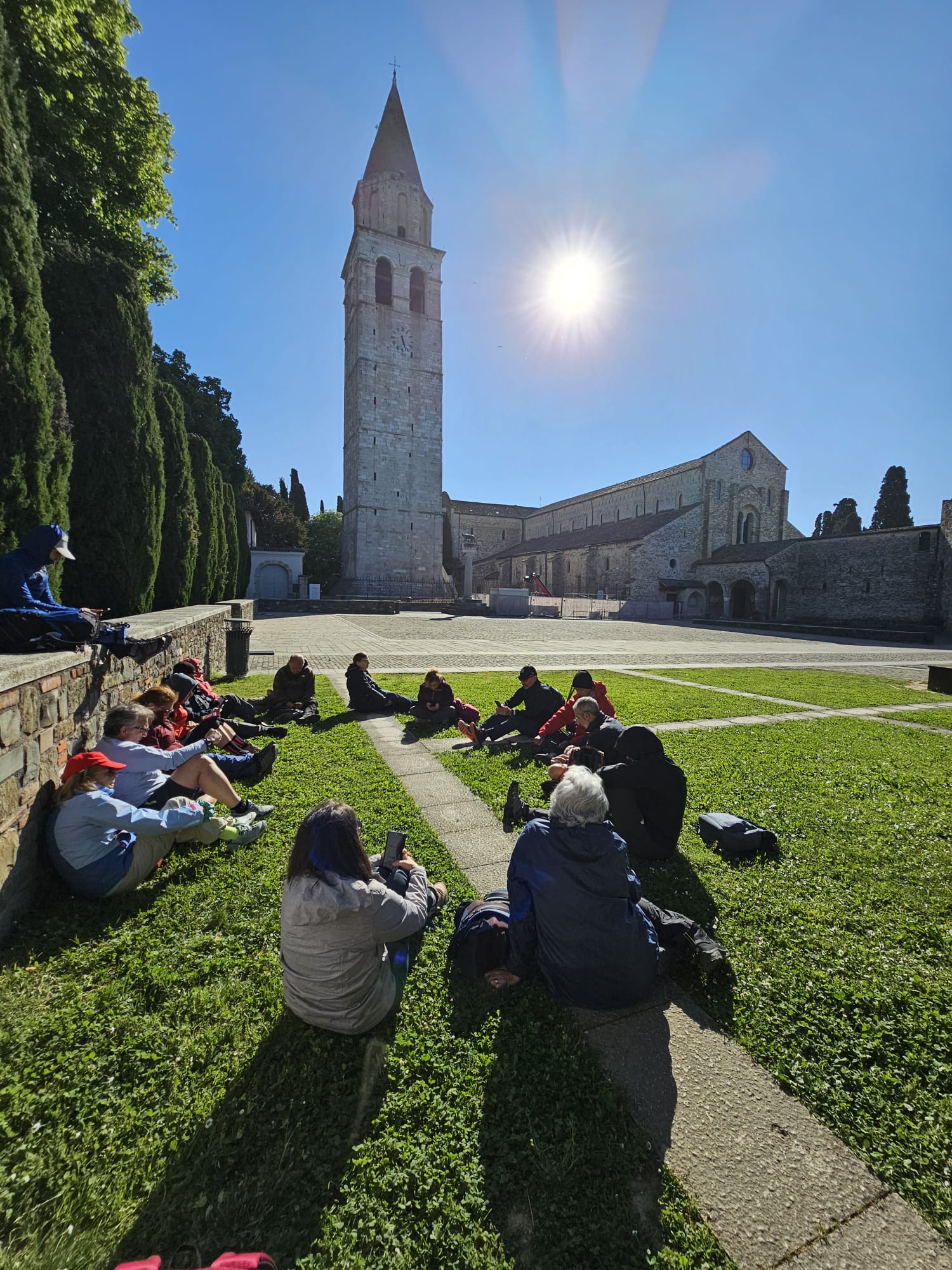
After kilometers of plain and silent roads, Aquileia appears quietly along the route. No dramatic entrance: it reveals itself slowly, like places that guard millennia of history.
Beneath its rural calm lies one of the most important cities of ancient Europe. Founded by the Romans in 181 BC, Aquileia was for centuries a key hub between the Mediterranean and Central Europe.
The Patriarchal Basilica is its spiritual heart. Entering it after days of walking is a powerful experience: soft light, deep silence, and one of the most extraordinary early Christian mosaics in Europe.
Outside, Aquileia remains calm and suspended. The surrounding countryside embraces it, while the air already carries the scent of the lagoon. The sea is not yet visible, but it is near: light becomes brighter, wind more open, sky wider.
Aquileia is a crossroads between history and spirituality, land and water, outer and inner journey.
Grado: between sea, history and light
Grado closes the route with a unique atmosphere. A lagoon city with Venetian and Habsburg traces, deeply tied to the sea.
After days of walking, it appears almost like a mirage: a strip of land between sky and water. The arrival is emotional—salt air, seagulls, and boats marking the end of the journey.
The historic center preserves the soul of the old Venetian island, while the Basilica of Sant’Eufemia dominates the heart of the town. The seafront invites one last walk at sunset over the Adriatic.
Spirituality, silence and inner journey
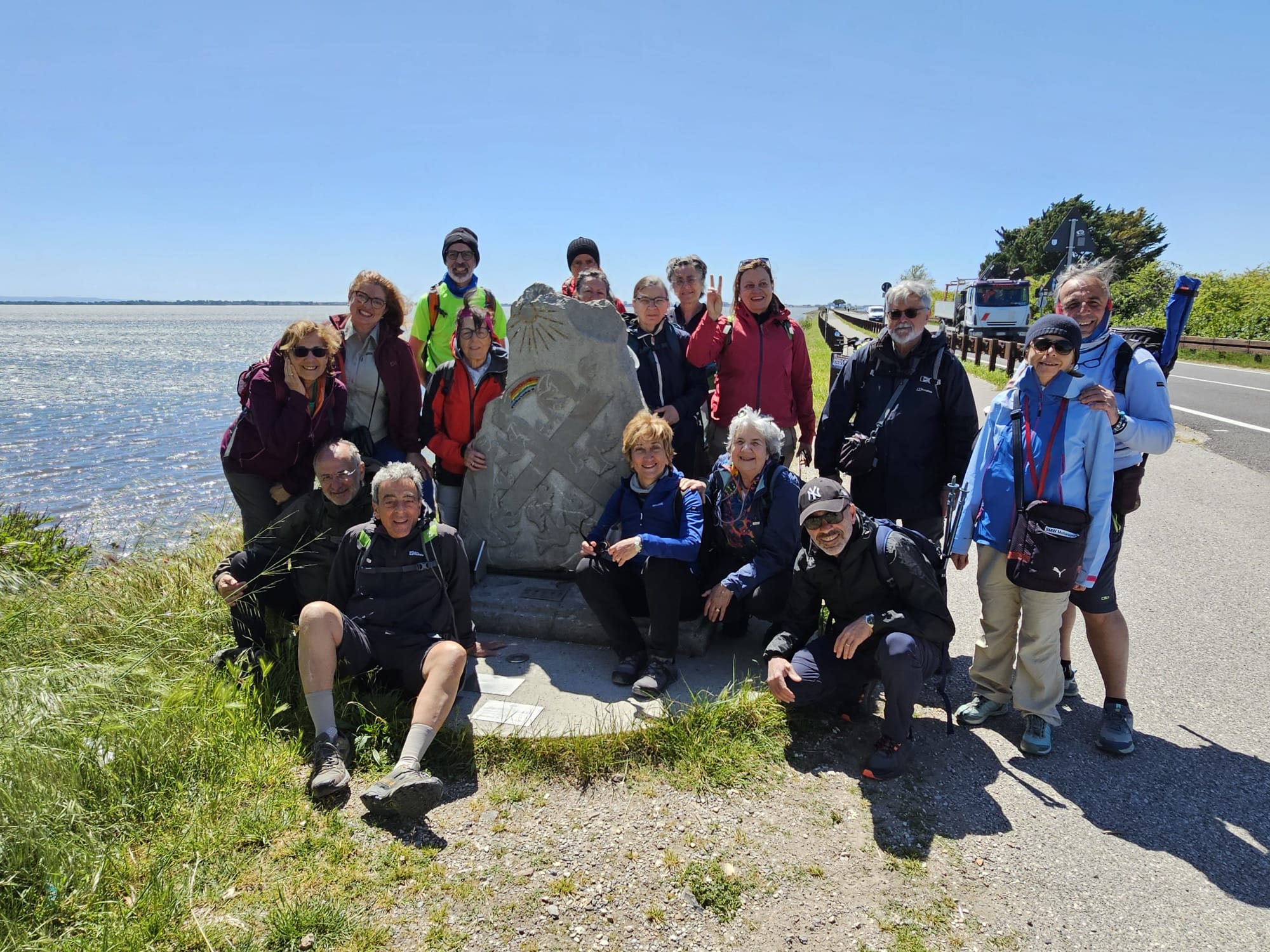
The Cammino Celeste remains deeply spiritual. It is not necessary to be a pilgrim to feel its meaning: walking slowly is enough. Sanctuaries, rural churches, and places of worship become points of pause and reflection.
Silence, slowness, and simplicity create a condition in which outer and inner journeys merge.
The Testimonium of the Cammino Celeste
Like other major European pilgrimages, the Cammino Celeste offers the Testimonium, the official certificate of completion.
It is more than a document: it is the tangible sign of a journey made step by step across mountains, plains, vineyards, and lagoons. To receive it, at least six stages must be completed, collecting stamps along the pilgrim credential.
Each stamp represents a place, an encounter, a moment. The credential tells the visual story of the journey.
The Testimonium symbolizes slowness, effort, and transformation—more than the end, it is the memory of everything experienced along the way.
Hospitality and local flavors
Hospitality along the route is natural and genuine. It appears in small gestures, shared tables, and local products. Cuisine reflects the land: frico, gubana, artisanal cured meats, mountain dishes, and Collio wines.
Every meal becomes part of the cultural experience.
A journey that stays in the heart
The Cammino Celeste is not only movement through space, but through time. One traveler described it:
“A path from the mountains to the sea… from Cividale to Barbana. A journey through landscapes, history, and hospitality. Friuli is beautiful. The Cammino Celeste is worth it.”
And so it is: a slow, profound journey where each day brings new landscapes, history, and authenticity.
The Cammino Celeste: the Slow Active Tours proposal
If you wish to experience the Cammino Celeste with an organized itinerary, logistical support, and selected accommodations, Slow Active Tours – a tour operator specialized in walking and cycling trips – offers full assistance, luggage trasportation, and trip customization.
Contact us for more information and enjoy a worry-free journey.