
In the heart of Umbria, among green hills and olive groves, Spoleto is a city that enchants with its timeless charm. Ancient, elegant, and cultured, Spoleto offers a perfect blend of art, music, spirituality, and nature, attracting thousands of visitors every year from around the world, thanks also to the famous Festival dei Due Mondi (Festival of Two Worlds).
In this guide, we will discover what to see in Spoleto, what to do, the main events, and the dishes to taste for a complete experience.
Founded by the Umbrians and later conquered by the Romans, Spoleto has always been a strategic city in the heart of the Italian peninsula. It was an important colony of the Empire and later the seat of the Lombard Duchy, traces of which still remain in its monumental heritage. During the Renaissance, it experienced a period of great cultural development, becoming home to noble families and patrons of the arts.
What to see in Spoleto
We have prepared a list of things not to miss in Spoleto, one of those places where every corner tells a story. A city of art and spirituality, music and nature, it is perfect for those seeking a deep and authentic cultural experience.
Visiting Spoleto means letting yourself be won over by its slow rhythms, the aromas of its cuisine, and the grandeur of its monuments.
Discovering what to see in Spoleto is not just a journey through works of art but an immersion into the most authentic soul of Umbria.
- Rocca Albornoziana and Ponte delle Torri;
- Duomo di Spoleto;
- Museo Diocesano and Basilica di Sant’Eufemia;
- Teatro Romano and Museo Archeologico;
And now let's set off together to discover the most identifying places in Spoleto!
Rocca Albornoziana and Ponte delle Torri
The Rocca (fortress) dominates the city from above with its imposing presence. From here begins the evocative Ponte delle Torri, a medieval aqueduct that connects the Rocca to Monteluco and offers breathtaking views of the valley.
The Ponte delle Torri is a majestic local limestone monument, 236 meters long. It is believed to have been built between the 13th and 14th centuries on a previous Roman aqueduct. Its name comes from the two fortresses located at its ends: the Rocca Albornoziana and the Fortilizio dei Mulini.
The Rocca Albornoziana is named after the Spanish Cardinal Egidio Albornoz, who was specially called to Italy by Pope Innocent VI to build a fortress in a strategic and dominant position on the summit of Colle Sant’Elia to restore the Pope’s authority.
Over time, it became the residence of various city governors, with numerous frescoes that were lost when the Rocca was used as a prison until 1982.
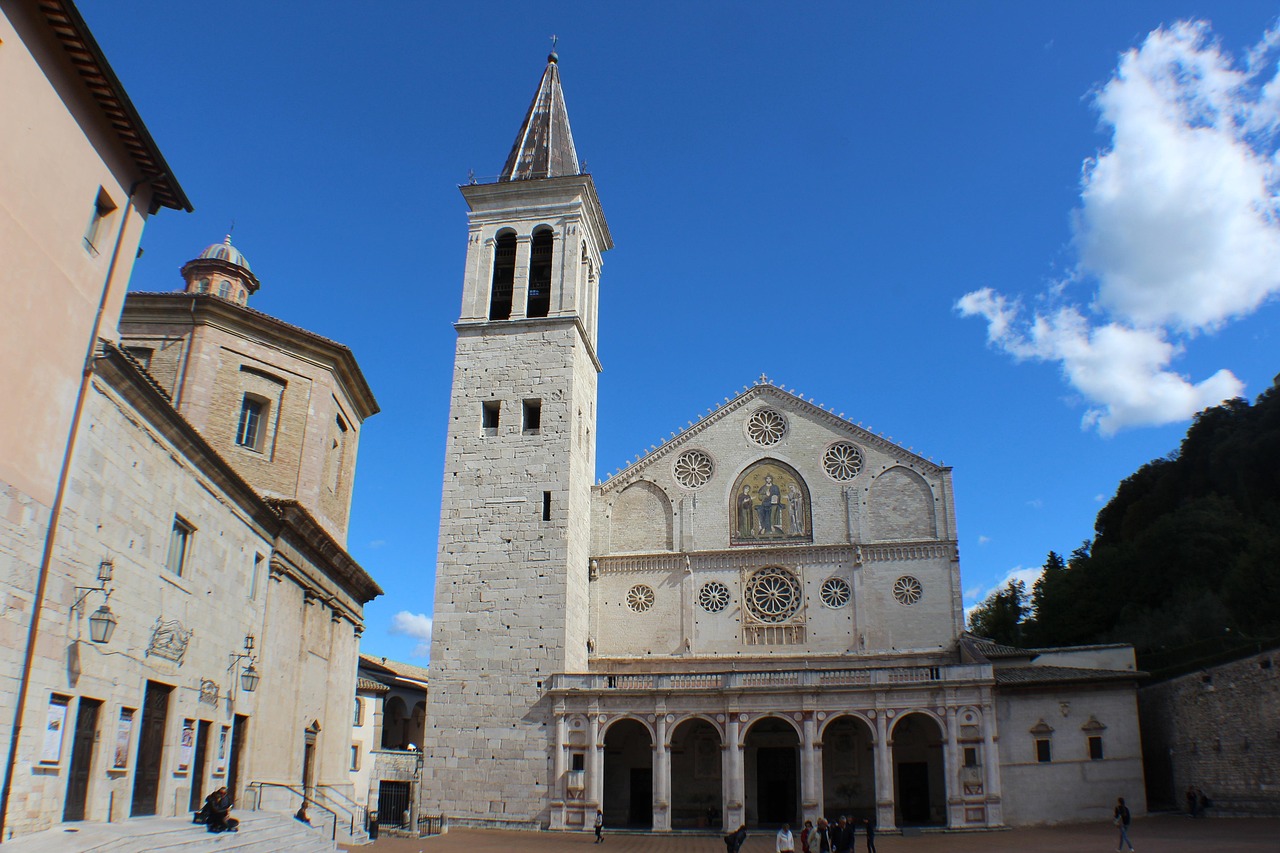
Duomo di Spoleto (Cattedrale di Santa Maria Assunta)
A masterpiece of Umbrian Romanesque architecture. Inside, you will find the famous fresco by Filippo Lippi and a precious Cosmatesque floor.
Built in Romanesque forms in the 12th century on the site of the ancient church of Santa Maria in Vescovado, it has undergone several transformations over time. The cathedral’s exterior is, in fact, a fusion of styles and decorations.
Museo Diocesano and Basilica di Sant'Eufemia
The museum houses sacred art and grants access to one of the city’s most evocative Romanesque buildings.
The museum was created to enhance and save from ruin the historical-artistic heritage of the Diocese of Spoleto-Norcia.
The works exhibited date from the 12th to the 18th century and are arranged according to chronological and thematic order in various rooms. In particular, the Hall of the Bishops stands out for its walls painted with portraits of the Bishops of Spoleto and for its refined furnishings.
The museum is located inside the Archbishop’s Palace, which also houses the Basilica of Sant’Eufemia, an exceptional example of Romanesque architecture with uncertain origins. The entire building was made using spolia (reused building materials) from Roman and early medieval times.
Teatro Romano and Museo Archeologico
Well-preserved remains of the ancient Roman theatre, with an attached museum that tells the archaeological history of the area.
The museum is housed in the former monastery of Sant’Agata, in the southern block of Spoleto’s historic center, in an area that in Roman times was occupied by the theatre.
Inaugurated in 1985, the museum is spread over several levels. Inside, you can admire artifacts from the entire territory, particularly from the Valentina area, which always had close ties with Spoleto.
There is also a section dedicated to illustrating the Roman theatre, where decorative sculptures discovered during the excavations of the 1950s are displayed. Among these is a statue of Aura, which recent studies recognize as an original 5th-century BC Greek marble, reworked in Roman times according to the standards of the goddess Venus linked to the Julio-Claudian dynasty.
An integral part of the museum visit is the theatre itself, dating back to the 1st century BC. It suffered partial dismantling during the Middle Ages but remains well preserved overall. The theatre hosts cultural events such as performances of the Festival dei Due Mondi.
What to do in Spoleto - the Slow Active Tours proposal
Spoleto offers many opportunities to experience the territory authentically.
For this reason, we have prepared a list of things to do in Spoleto that you absolutely cannot miss!
The Festival dei due Mondi is one of Europe’s most prestigious cultural festivals, founded in 1958 by Gian Carlo Menotti, who chose the Umbrian city for its deep theatrical tradition.
Since 1956, music, dance, theatre, visual arts, and international performances have filled Spoleto’s squares, theatres, and cloisters.
The prestigious festival hosts the best international performing experiences, enhancing theatres, open spaces, and unconventional venues.
Spoleto Arte is an event that promotes contemporary art in the city’s historic sites, with exhibitions, installations, and performances.
Spoleto Arte is a major observatory on contemporary art, offering a broad and important overview of expressive styles.


Festivals and Popular Celebrations in Spoleto
Spoleto is deeply connected to its agricultural and religious traditions, celebrated with authentic and engaging events.
La Festa della Madonna di Loreto A traditional religious festival with celebrations, music, and illuminations in the neighborhood of the same name.
The celebrations in honor of the Madonna di Loreto have very ancient origins. The traditional fair was instituted in 1598 by Pope Clement VIII. It lasted eight days during which special customs exemptions and immunities were granted.
The start date was set to April 21 to commemorate a miracle that occurred seven years earlier. Spoleto had been hit by a violent earthquake. The frightened population, terrified by the incessant tremors, gathered in prayer before the image of the Madonna inside a modest chapel.
It is said that the image moved its eyes in the presence of many praying Spoletans, and the tremors ceased.
There is no certain information about when the fair was moved to September, but it is known it was done because September 8 marks the Nativity of the Virgin Mary.
Spoleto Tipica is the festival dedicated to local products, with tastings of olive oil, truffles, local wines, and Umbrian dishes. It takes place in Spoleto’s historic center and is an opportunity to discover and taste local specialties such as Spoleto ham, maccheroni with offal, risotto with sregoli, and strangozzi alla spoletina. Spoleto Tipica is the perfect occasion to immerse yourself in the culture and gastronomy of this beautiful Umbrian city.
Visiting Spoleto during Holy Week is an opportunity to witness the rituals leading up to Easter. The events of Good Friday, in particular, are among the oldest and most solemn in Umbria.
The streets of the historic center are crossed by a suggestive nighttime torchlight procession that leaves visitors of all cultures and religions breathless.
Typical Dishes of Spoleto: Intense and Genuine Flavors
Spoleto’s cuisine reflects its people: simple and robust, linked to the products of the land and farming tradition.
Farro with vegetables or legumes is a humble and nutritious dish, very popular in the area and available all year round.
Strangozzi with black truffle are typical handmade Umbrian pasta, seasoned with black truffle from Valnerina, one of the region’s most prized products.
Palomba alla ghiotta is a traditional recipe made with wood pigeon, cooked with spices, wine, and pancetta. A true local delicacy. For the sweet tooth, there is the crescionda spoletina, a typical dessert made with milk, chocolate, amaretti, and liqueur, with a texture somewhere between pudding and cake.
Eating and Drinking in Spoleto
Here are some proposals from the area:
Now that you know what to see in Spoleto, all you have to do is lose yourself in its narrow streets and let the scent of warm bread and the distant sound of bells guide you.