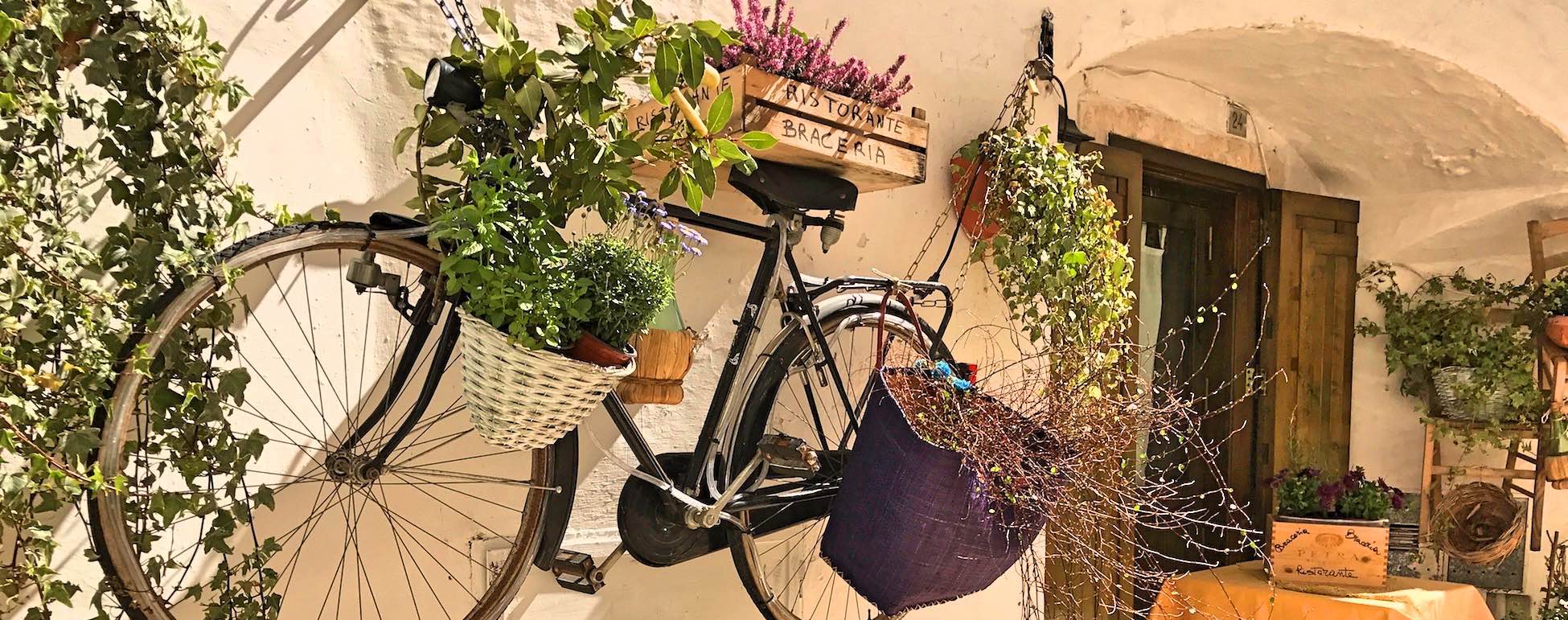

Visiting Lucera is like consulting an ancient manuscript layered with the culture of the peoples who have lived here. The Sentinel of Puglia has always benefited from a privileged geographical position, perched on the top of three hills in the heart of the Tavoliere, overlooking vineyards, olive groves and vast expanses of wheat.
The town stretches across three hills overlooking the Tavoliere delle Puglie. All around, fields of wheat, centuries-old olive trees and excellent vineyards surround a historic centre that is particularly rich in architectural and cultural heritage. A wonderful maze of narrow streets suddenly opens onto charming churches and ancient monuments. Lucera has preserved its remarkable artistic and cultural heritage, making it one of the most important towns in southern Italy.
Visiting Lucera means discovering a city with very ancient origins, long disputed because of its strategic position, which allowed control over the Tavoliere delle Puglie.
The city played an important role during the Samnite Wars and was the setting for the famous Battle of the Caudine Forks, one of the most renowned defeats and humiliations suffered by the Roman army.
Despite this defeat, the Romans eventually prevailed and conquered the disputed territories. Numerous architectural works date back to this period, including the city walls and the amphitheatre.
Between the 16th and 19th centuries, the city experienced a period of strong expansion and prestige, becoming the capital of Capitanata, a historic and cultural region of northern Puglia.
What to see in Lucera
Lucera is the starting point of the Via Micaelica, a new and fascinating route connecting sanctuaries dedicated to the Archangel Michael. We recommend taking some time to explore the town. For this reason, we have put together a list of the best things to see in Lucera in one day. And now, let's discover these places together!
Lucera Castle
When exploring the things to see in Lucera in one day, there is no better place to start than one of the symbols of the city: the Swabian-Angevin Castle.
The Swabian-Angevin Castle was built around the 13th century on the top of Mount Albano, where the acropolis of Roman Lucera once stood. In the 13th century, it developed as a Palatium to control the Saracens whom Frederick II had deported from Sicily to Lucera. It was under Charles I of Anjou that the building was transformed into a true fortress. Today, the entire area represents a remarkable historical treasure where traces of different periods can be seen, from Neolithic huts to the remains of a single-nave church with an adjoining sacristy dedicated to St Francis of Assisi.
Carmine Church
In Lucera's architectural landscape, the church and adjoining convent of Santa Maria del Carmelo represent the most significant example of Baroque art. The imposing complex was built between 1754 and 1755 by the Carmelite Fathers, replacing their old and now deteriorated settlement located in the Pozzo del Carmelo area along the road to Foggia.
In line with practices that may seem questionable today but were widely accepted at the time, materials taken from the ancient Swabian-Angevin Castle, which was already abandoned, were used to build the church. Despite this, the building quickly acquired a noble and monumental character, also thanks to the generous contributions of several aristocratic families from Lucera, including the De Grazia, Lombardi, del Vecchio and the Marquises Scassa. The works were directed by the master engineer Ludovico di Tullio, originally from Pescopennataro.
In 1794, the Carmelites were forced to leave the convent, and it was not until 1937 that the church became the seat of the historic parish of San Matteo, previously located near the ancient Roman baths of Porta San Severo.
The elegant Baroque façade leads into a richly decorated interior, enhanced by refined stucco details. The church has an elongated cross-shaped layout and features six side chapels, each containing remarkable examples of sacred art.
The first altar on the left, under the patronage of the Lombardi family, houses an altarpiece depicting Saint Teresa of Ávila, painted by Ermenegildo Costantino in 1659. Next comes the Chapel of Our Lady of Sorrows, commissioned by the Marquises Scassa, where a magnificent polychrome marble altar can be admired. It was created by the renowned marble craftsman Michele Salemme in 1759. The structure stands out for its bold vertical design and rich decoration, with a striking combination of colours and materials, including brick-red Verona stone with dark shades. At the centre of the altar is a valuable painting of Our Lady of Sorrows by Francesco De Mura, a pupil of the master Luca Giordano.
The high altar is also particularly impressive, dominating the entire presbytery with its majestic presence. Other notable works preserved inside the church include a precious Byzantine icon of Our Lady of Mount Carmel with the Child, dating from the 15th century, and a painting of Our Lady of Miracles dating from 1602.
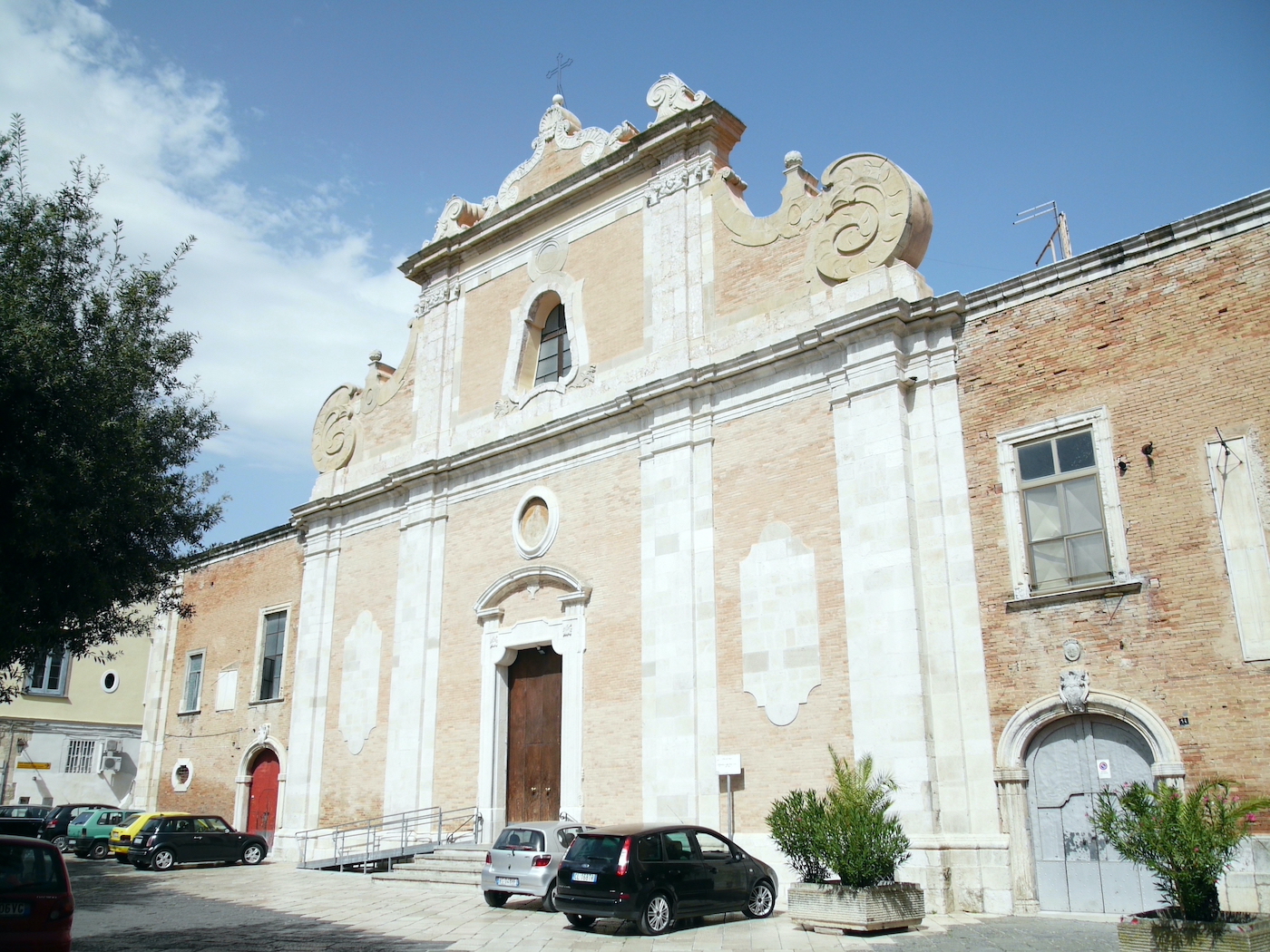
Carmine Church in Lucera - Visit Monti Dauni
Cathedral Basilica of Santa Maria Assunta
After Christian rule was restored in Lucera following the defeat of the Saracens, a new cathedral was built in the Gothic-Angevin style, probably on the site of the demolished mosque, between 1302 and 1317. Its distinctive asymmetrical façade in terracotta and white stone is nevertheless harmonious. The right-hand nave is accompanied by a powerful square bell tower, featuring elegant Romanesque bifora windows and Gothic single-lancet windows arranged across several levels. An octagonal lantern crowns the tower. The façade features a rose window and three pointed stone portals with canopies. The interior of the basilica has a Latin-cross layout, with three naves and three Gothic apses. Its current appearance is the result of restoration works carried out in the 19th century to restore the original Gothic character, removing later decorative additions.
The Cathedral houses works of considerable historical and artistic value, including a baptismal font and a 15th-century ciborium.
Roman Amphitheatre
The Roman amphitheatre dates back to a period between 27 BC and 14 BC and most likely reflects a new phase of urban planning that took place during this period.
The monument was commissioned by a local magistrate who held a prestigious position and demonstrated the local ruling class's support for the political programme. This reflected a widespread practice in the ancient world, whereby private individuals funded the construction of public buildings for the benefit of the community.
The amphitheatre is 130 metres long and 95 metres wide and is estimated to have had a capacity of around 18,000 spectators.
San Francesco Sanctuary
The building was constructed in the 14th century at the initiative of Charles II of Anjou, who restored the city to Christianity after a long period of Arab-Muslim rule. The church has a simple and slender masonry façade, whose sobriety is interrupted by an arch decorated with sculptural elements, the Angevin coat of arms and a splendid 16-ray stone rose window reconstructed in 1943.
The single-nave interior preserves traces of 18th-century frescoes depicting episodes from the life of St Francis of Assisi. The polygonal apse, meanwhile, is decorated with frescoes depicting scenes from the Passion. The Sanctuary preserves the relics of Padre Maestro, Saint Francesco Fasani, the first saint of Capitanata, who lived here for 35 years and was canonised in April 1986 by Pope John Paul II.
Reading this article and already looking forward to visiting Lucera?
Discover our travel experiences and set off on your next adventure!

Via Micaelica: from Benevento to Monte Sant'Angelo
Self-guided walking tour
What to do in Lucera - the Slow Active Tours proposal
Visiting Lucera allows you to take a journey back into the city's medieval past. One of the most fascinating things to see in Lucera in one day is undoubtedly the Torneo delle Chiavi and the Corteo Storico.
This is a historical re-enactment of medieval games that were granted to the people by Frederick II. In the evocative setting of the Roman Amphitheatre, representatives of the five districts into which the city was once divided compete in a series of tests of strength and skill. The district that wins the tournament receives a 14th-century banner depicting Saint Mary, Patroness of the city, with the Child. The trophy is carried in procession on 14 August, when the liberation from Saracen occupation is commemorated, and is symbolically presented to the city's Patron Saint at the end of the Historical Procession. The re-enactment recalls the events that took place on the evening of 14 August 1300, when the commander Pipino da Barletta defeated and expelled from Lucera the last Arab colony established by Frederick II of Swabia, thus restoring the city to Catholic rule.
During your day in Lucera, you can also visit the Giuseppe Fiorelli Civic Museum, housed in the 18th-century Palazzo Cavalli and named after the Neapolitan archaeologist of Luceran origins, Giuseppe Fiorelli.
The museum was established in 1905 by a group of private citizens and houses important artefacts covering a period from prehistoric times to the Middle Ages. Particularly interesting is the medieval archaeology section, which offers important evidence of Lucera during the time of Frederick II, including glazed Saracen pottery that documents the period when the city became an Arab colony.
Festivals and Popular Events in Lucera
The city of Lucera has a lively cultural scene, with numerous traditional and food-related events taking place throughout the year.
The Feast of the Patron Saint of Lucera, dedicated to Santa Maria dell'Assunta, takes place every year from 14 to 16 August. Over these three days, the city is decorated for the celebrations and comes alive with markets, marching bands and stalls. The traditional procession on 16 August follows a rich programme of shows, concerts and theatre performances.
Typical dishes of Lucera
Visiting Lucera is the perfect opportunity to discover and taste the local food and wine traditions. The town's traditional baked product is Pane di Lucera, still handmade and naturally leavened.
Local wine production is also an important part of the area's traditions, including the famous Cacc' e mmitte di Lucera DOC, whose name comes from an ancient winemaking process. In the past, this local wine was produced in so-called palmenti, traditional farm structures equipped with vats that landowners made available to farmers for pressing grapes. The equipment could only be used for one day, after which the winemaker had to leave the palmento available to another farmer. These quick operations of taking out (cacc') and putting in (mmitte) the grapes gave the wine its name. It has a ruby-red colour with violet hues and is mainly produced from the Uva di Troia grape variety.
If you decide to spend a day visiting Lucera, we recommend trying one of the local dishes with a rather unusual name. We are talking about mambrikule, whose appearance is very similar to couscous. The name comes from the combination of two words meaning "hands" and "crumbs" and refers to an old local tradition according to which mothers and children would prepare this pasta together on Christmas morning. Once the dough had been prepared, the children were responsible for breaking it into small crumbs. The dish was completed with a tasty broth, part of which was added to the dough while the rest was used to cook the pasta.
Eating and Drinking in Lucera
Here are some local recommendations:
Trattoria Colpa d'Alfredo, Via Giovanni Bovio, 9. An informal and welcoming restaurant, just a short walk from Piazza Duomo and the cathedral. Simple dishes made with carefully selected local ingredients and original combinations.
Il Fico, Vico Caropresa, 9. A modern and stylish venue with an industrial design. Its menu features a selection of the finest local specialities.
Dentro al Vicolo, Via Famiglia Scassa, 18/20. A restaurant located in what was once a wine cellar, renovated to create a very characteristic atmosphere.
So, what are you waiting for? Pack your backpack and let's go!