
Visiting Brindisi is a fascinating journey through the different cultures that have coexisted here for centuries. Each of them has left its mark, making the city's history truly unique.
Brindisi is an ancient city home to one of the largest natural harbours in the Mediterranean. An ancient crossroads of peoples and cultures, it is a natural meeting point between East and West. Its beauty has inspired thousands of travellers throughout the centuries. The history of ancient Brindisium was in fact strongly influenced by the strategic position of its natural harbour. Its shape resembles the head of a deer: a unique characteristic that made it virtually impregnable for centuries.
Visiting Brindisi and strolling through the narrow streets of its historic centre feels like travelling back to the time when these places were a crossroads of civilisations and peoples. Brindisi was in fact an important point of reference for pilgrimages to the Holy Land and for trade with the East. The iconic Scalinata Virgilio is dedicated to the Latin poet who stayed here on his return from the East.
Brindisi is known as “The Gateway to the East”, and this is the complete guide to discovering and getting to know its artistic and architectural heritage, which fully reflects its thousand-year history.
What to see in Brindisi
Why not spend a carefree day discovering the beauty of this fascinating city overlooking the Adriatic while reaching towards the East?
If you want to spend a day exploring Brindisi, we have prepared a list of the things to see and visit at your leisure:
- Basilica of the Visitation
- San Giovanni al Sepolcro
- Alfonsino Castle
- Church of San Benedetto
- Church of Santa Maria del Casale
And now let's set off together to discover the most iconic places in Brindisi!

Basilica of the Visitation
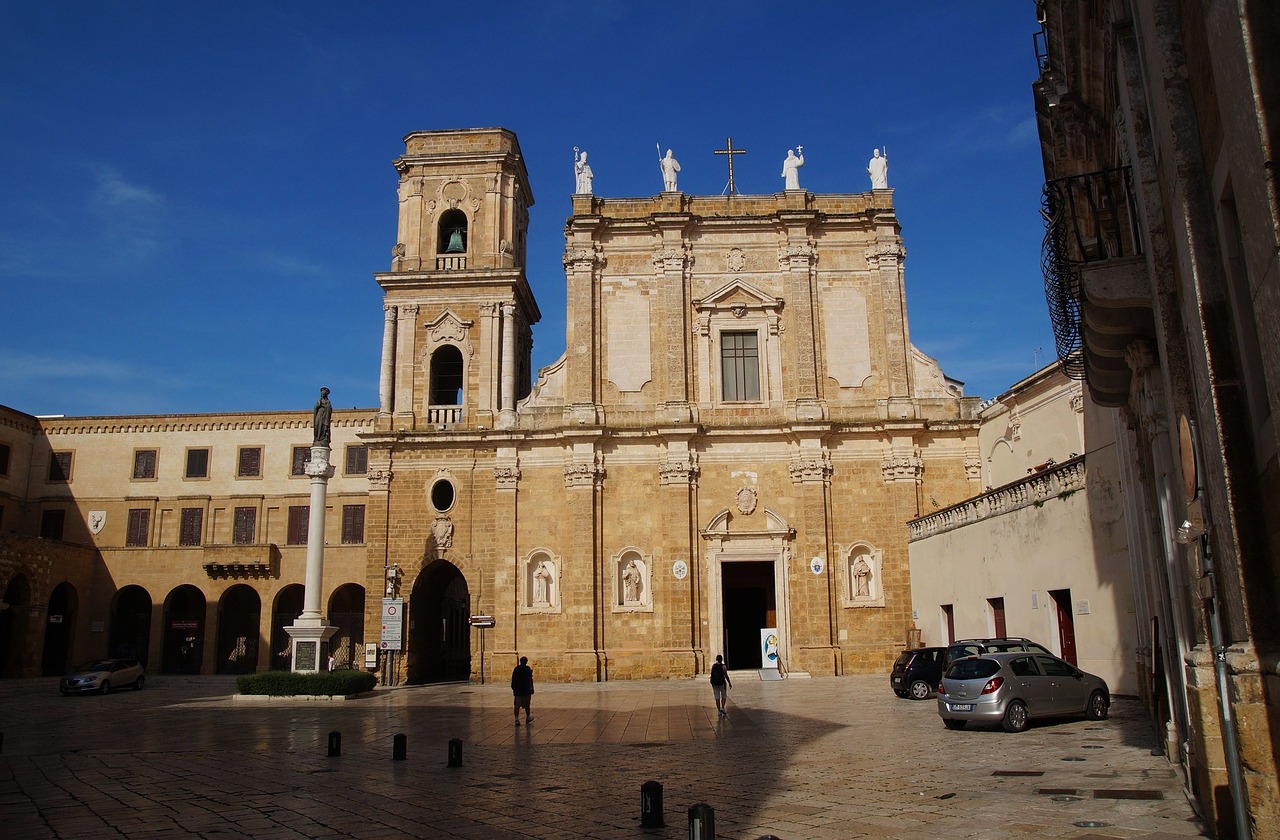
A guide to the city that allows you to visit Brindisi and its most iconic landmarks can only begin with the beautiful Cathedral. Consecrated by Pope Urban I in 1089 and then completed in 1143 following the principles of Romanesque architecture, it represents a fundamental landmark in the medieval history of Europe. In 1191, in fact, Roger, son of Tancred, was crowned King of Sicily here.
It is also said that the Crusaders gathered here in prayer before setting off for the Holy Land.
Unfortunately, very little remains of the original structure, which was destroyed following the earthquake that struck the city on 20 February 1743. Of the Romanesque church, visitors can still admire the three-nave layout and other architectural features.
San Giovanni al Sepolcro
The monument was built by the military order of the Canons Regular of the Holy Sepulchre before 1128. The church went through a period of abandonment and decay until it became the property of the municipality in 1868.
It represents the close connection between Brindisi and the Holy Land during the period of the Crusades. The building was in fact designed as a replica of the Tavola Rotonda of the Holy Sepulchre in Jerusalem. The intention was to leave a reminder for those returning to Brindisi after their pilgrimage and to give them the opportunity to see the holy places in person.
The structure has a circular layout, cut off to the east by a straight wall. The eight columns of the central ring are connected to the perimeter walls by round arches. The paintings inside refer to the Byzantine tradition, over which later decorations were added. Particularly evocative are the graffiti found both inside and outside. They tell of the passage of pilgrims, knights and ordinary people who wanted to leave an indelible mark on the walls of this building, which continues to evoke strong emotions today, just as it did in the past.
Alfonsino Castle
For years, Alfonsino Castle represented a defensive stronghold for the entire western world in opposition to Ottoman expansion. In 1481, while the Turkish fleets were besieging Otranto, Ferrante of Aragon decided to build a fortress to guard the port of Brindisi. Four years later, Ferrante's son Alfonso transformed the tower into a true castle, already considered at the time a masterpiece of defensive architecture.
The Forte a Mare, as it was already known at the time to distinguish it from the land-based castle, was built during the second half of the 16th century.
Church of San Benedetto
The Church of San Benedetto was built between the end of the 11th and the beginning of the 12th century, when the city and much of southern Italy were under Norman rule.
The original structure's cloister and bell tower have survived, while the convent opposite was restored in the 18th century.
The imposing structure is a typical example of Romanesque art, although its present appearance is completely different from the original. The façade is no longer visible, and the portal was dismantled and rebuilt on the side wall, where it can still be seen today.
The entire exterior is characterised by a sequence of blind arches framing single-lancet windows decorated with white stone and golden carparo.
The ancient 11th-century portal is finely decorated with interwoven vine motifs and small carvings.
Church of Santa Maria al Casale
According to tradition, the church was built in the Romanesque-Gothic style during the 13th century, on the site where Saint Francis of Assisi is said to have stopped to pray on his return from his pilgrimage to the Holy Land. The interior houses a magnificent cycle of precious and refined Byzantine frescoes, some of which are signed by Rinaldo da Taranto. These precious works came to light after more than two centuries thanks to a delicate restoration project.
Adding to the aura of fascination and mystery surrounding the building is the tradition that in 1310 Santa Maria al Casale was the setting for the trial of the Templars on charges of heresy and idolatry.
What to do in Brindisi - the Slow Active Tours proposal
Visiting Brindisi allows you to discover the hidden wonders among the narrow streets of the historic centre, such as the neighbourhoods perched around the harbour that have become authentic fishing villages. It is time to immerse yourself in the sounds and aromas of the Gateway to the East.
-
History Digital Library
The History Digital Library is a community library located in the “Casa del Turista” on Brindisi's seafront. An innovative library conceived as a space for learning and taking part in history-themed events.
The building is divided into two floors: on the first floor is the Book Experience, a sensory journey designed to encourage visitors to discover the materials and tools used before the invention of printing. On the second floor is the Community Library, equipped with technological resources and book collections. -
Provincial Archaeological Museum "F. Ribezzo"
A reference point for local archaeology thanks to the numerous artefacts unearthed during excavations in the city. Inside, it houses prestigious and unique international finds, including the Portico of the Knights Templar, which serves as the entrance to the museum itself. The new premises, inaugurated in the early months of 2009, extend across a two-floor route that allows visitors to discover the civilisations that successively inhabited the area, from prehistoric times through to the Roman period.
-
Archaeological Area of San Pietro degli Schiavoni
The Roman-era archaeological area, brought to light between 1964 and 1966, takes its name from the Church of San Pietro, of which no trace remains, and from the Schiavoni, the people who inhabited the area from the 16th century onwards together with Greeks and Albanians.
As often happens, the discoveries were made by chance during the demolition of houses. This brought to light an area of approximately 4,800 square metres, part of which can be seen beneath the Nuovo Teatro Comunale. The entire area is characterised by a paved road running through it, the main axis of the urban layout of Roman-era Brindisi. Another important feature is the late Imperial-era thermal complex, characterised by several heated rooms and a room with a marble floor. -
Palazzina del Belvedere - S. Faldetta Archaeological Collection
It takes its name from the splendid terrace overlooking Brindisi's seafront and preserves important archaeological evidence from across the Puglia region. These include several varieties of Messapian, Mycenaean, Corinthian and Attic ceramics. The collection also includes several unique pieces, such as a proto-Apulian bell krater dating back to the 4th century BC, which Professor Arthur Trendall attributed to the Tarporley Painter.
-
Trekking along the Via Ellenica
Slow Active Tours offers an exciting and intriguing walking journey to discover the hidden beauty of Puglia, from the inland countryside to the Adriatic coast.
Festivals and Popular Events in Brindisi
Visiting Brindisi is an opportunity to discover and take part in the many festivals and popular celebrations that enrich the folklore of this region. The Procession of the Decorated Horse takes place in June on the occasion of Corpus Christi. During the celebration, the city's bishop carries the Eucharist in procession through the streets of the historic centre on a white “decorated” horse. According to legend, King Louis IX of France was taken prisoner in Egypt during a battle in 1250. Having left the Eucharist as a pledge, he reached Brindisi, where Frederick II had the money needed for his release minted. Upon returning to Egypt, the King of France was freed by Saladin, who also returned the Eucharist to the monarch as a gesture of gratitude. On his way back from Egypt, Louis IX was caught in a storm and was forced to stop a few kilometres south of Brindisi. At that point, the elderly Bishop Pietro reached him on a white horse, carrying the Eucharist into the city.
The Feast of the Patron Saints of Brindisi takes place from the last Sunday of August through the first days of September. On this occasion, traditional craft and food stalls fill the streets of the city centre, set against the spectacular backdrop of the festive illuminations.
One event not to be missed is undoubtedly the procession by sea of the statues of Saint Lawrence and Saint Theodore, the city's patron saints, which are carried aboard a boat between Alfonsino Castle and the central quay.
The procession by sea commemorates the miraculous arrival of Saint Theodore's relics in Brindisi. It is said that in 1210 some Venetian sailors were forced to entrust the saint's relics to a boat without a helmsman because they were being pursued by enemy ships. Carried by the current, the relics of Saint Theodore reached the city's shores, where they were welcomed and venerated as a sign of gratitude for the saint's willingness to protect the people of Brindisi.
The Palio dell’Arca is a competition between small fishing boats, known in the local dialect as schifarieddi, which closely resemble those that accompanied the arrival of Saint Theodore's relics in the harbour.
Traditional Dishes of Brindisi
The cuisine of Brindisi is genuine and full of character, a perfect blend of land and sea that should not be missed when exploring the city.
Fresh pasta, strictly handmade, is undoubtedly the queen of traditional Puglian cuisine, and even more so in Brindisi. One delicious speciality to try is strascicati, handmade pasta simply dressed with tomato sauce and cacio ricotta.
The Brindisi artichoke, protected by the PGI quality mark, is a fundamental ingredient in many traditional recipes from the area. Its distinctive purple, thornless appearance makes it the special ingredient in a delicious recipe. We are talking about stuffed artichokes, a simple and quick recipe with humble origins but refined flavours that enhance the quality of the product. After blanching the artichoke, a soft and substantial filling made with bread, grated cheese, egg, oil and herbs is added, and the dish is left to finish cooking.
The fava bean purée is another traditional dish with very ancient origins. In fact, in the local dialect this dish is known as 'ncapriata', a Latin adaptation of caporidia, which in turn derived from the Greek kapyridia, the name used for a type of polenta made from crushed wheat. In some areas of Puglia, fava beans are served with seafood, aubergines or wild spring onions. In the Brindisi area, however, they are enjoyed with chicory, creating a combination of the sweetness of the fava beans and the slightly bitter notes of the chicory.
Eating and Drinking in Brindisi
Here are some local suggestions:
Cascipò at Via S. Benedetto, 45. An elegant traditional restaurant serving delicious fish-based cuisine just a few steps from the port and cathedral of Brindisi.
La Locanda del Porto at Via Montenegro, 20. An atmospheric setting on the street with a glimpse of the sea of Brindisi. The 10-course traditional appetiser is highly recommended and very tasty!
Vinoteca Numero Primo - Viale Regina Margherita, 46. An excellent wine bar overlooking the port of Brindisi. Outdoor seating is also available. It offers excellent wine and high-quality food.
So, what are you waiting for? Backpack on and let's go!